F1 Visa Rejected 214b: What to Do Next


Estimated reading time: 13 minutes
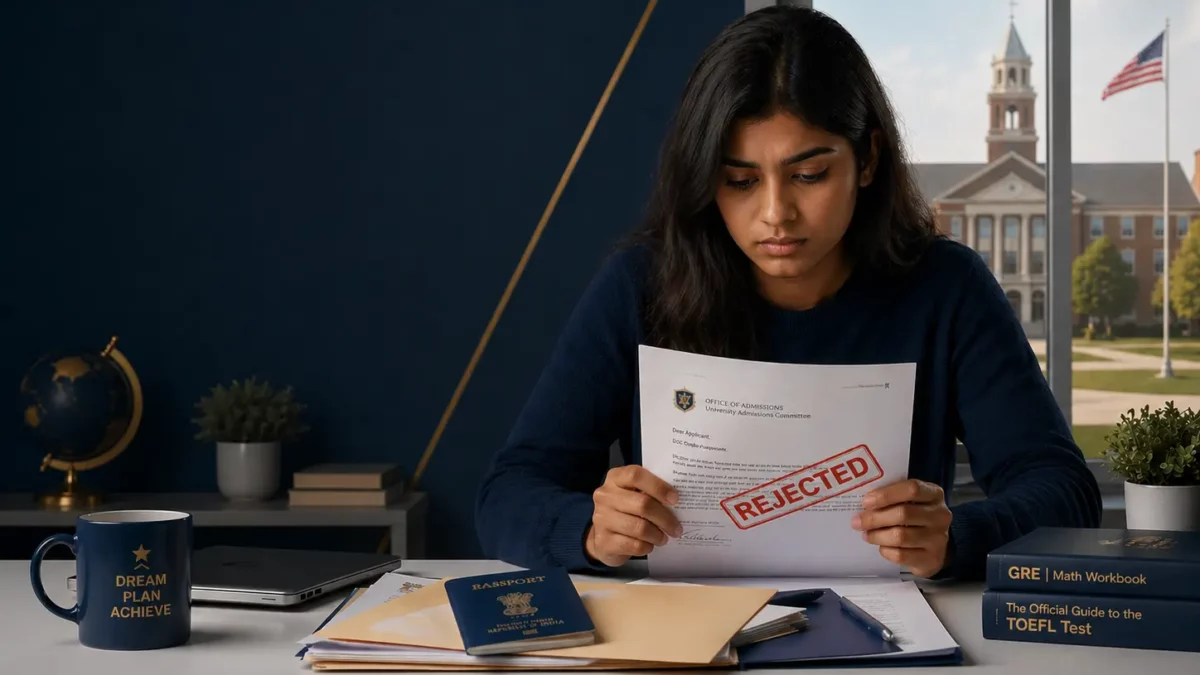
A few weeks ago, a message landed in our inbox at Bluehawks Edu. A student had just received an F1 visa rejected 214b outcome at the US consulate in New Delhi. She held a dual degree from one of India’s most selective private engineering institutions, based in a small desert town in Rajasthan, roughly 200 kilometres west of Delhi. Her admit was to an MS in Electrical and Computer Engineering at a public research university on the West Coast of the United States, one that ranks consistently among the top 15 ECE programs in the country.
On paper, this was the kind of profile that makes admission consultants comfortable and parents proud. It still ended in a refusal.
When we sat down to review her case, something became clear almost immediately. The interview was only the second problem. The first problem had been sitting quietly inside her DS-160, weeks before she ever stood at that consulate window.
This blog covers both problems. If you are preparing for your F1 visa right now, or figuring out what went wrong after an F1 visa rejected 214b result, this may be the most useful thing you read before your next appointment.
Table of contents
- What Section 214(b) Actually Means for F1 Applicants
- The Two Problems Nobody Talks About Together
- Act One: The DS-160 Is Where Most F1 Visa Rejected 214b Cases Begin
- Act Two: The Interview Problem and Why the DS-160 Sets Its Tone
- What Proper Preparation Looks Like for a Complex Profile
- Why Strong Profiles Still Get an F1 Visa Rejected 214b Result
- What to Do Next If You Got an F1 Visa Rejected 214b Result
- Frequently Asked Questions About F1 Visa Rejected 214b Cases
- How Bluehawks Edu Helps You Avoid an F1 Visa Rejected 214b
What Section 214(b) Actually Means for F1 Applicants
Section 214(b) of the Immigration and Nationality Act presumes that every visa applicant intends to immigrate permanently to the United States unless the applicant can prove otherwise. The burden of proof sits entirely on you. The consular officer does not need to prove you will overstay. Proving that you will leave is your job.
For F1 student visa applicants, this means demonstrating three things clearly:
- You have a genuine academic purpose for studying in the United States
- You have strong ties to your home country that will compel you to return
- Your overall profile does not suggest immigrant intent
An F1 visa rejected 214b outcome does not mean you lied. It means you failed to convince. That distinction matters enormously when you begin preparing for a reapplication.
The Two Problems Nobody Talks About Together
Most visa prep content online focuses on the interview. Practice your answers. Dress professionally. Know your program details. All of that matters, but it is the second half of the preparation, not the first.
The F1 visa process has two distinct stages where your case is either built or broken. Most students only prepare for one of them.
Stage One is the DS-160.
Stage Two is the interview.
Here is the part that changes everything once you understand it. By the time you reach the consulate window, the officer has already read your DS-160. A preliminary picture of your profile has already been formed. Every question the officer asks is shaped by what they saw in that form.
If your DS-160 is vague or inconsistent, the officer walks into the conversation looking for gaps. If your DS-160 is a coherent and well-constructed narrative, the officer walks in looking to confirm what they have already understood.
The interview either continues a story or tries to rescue one.
Act One: The DS-160 Is Where Most F1 Visa Rejected 214b Cases Begin
What Most Students Actually Submit
Here is what the average strong-profile student submits in their DS-160:
Current occupation: Student. Degree: Dual degree in EEE and Mathematics. Applying for: MS in ECE. US contact: Relative residing in the United States.
Every field is technically accurate. Together, they are almost completely useless as a visa document.
The DS-160 is not a form. It is a narrative document. Every field you fill is a chance to either build your case or leave a gap that an officer will fill with suspicion. Most students treat it like a form because it looks like one. That single mistake silently drives more F1 visa rejected 214b outcomes than any interview fumble ever could.
What Was Missing From This Student’s DS-160
When we reviewed this case, several critical elements were either absent or handled in a way that created more questions than answers.
Current duties and occupation: She was a recent graduate with a dual degree. What was she doing at the time of application? Research, projects, freelance work, academic activity since graduating? None of it appeared. The DS-160 read as if she had been sitting idle since finishing her degree, which is both a missed opportunity and a quiet red flag.
The dual degree explanation: A dual degree combining Electronics and Electrical Engineering with Mathematics is unusual to many people outside the Indian engineering system. To a consular officer processing hundreds of applications a week, it requires explanation. Why did this academic combination lead to an MS in ECE application? What is the logic? It was never addressed, so the officer had to guess. Officers who guess tend to land on the cautious interpretation.
The purpose of the US program: The DS-160 listed the program name and institution. What it never explained was the specific gap this program was designed to fill. Why this university? Why this specialization at this point in her career? Why not a program in India? Your DS-160 should answer these questions before anyone needs to ask them out loud.
The US relative: A close relative living in the United States is a known immigration intent flag. Listing it as a contact detail and leaving it there does quiet damage. The relationship, their status, and the applicant’s financial independence from them all needed to be proactively framed.
Post-study intent: No directional statement about post-graduation plans appeared anywhere in the DS-160. No India-based career goals, no industry entry points, nothing that made returning home feel like a natural conclusion rather than an afterthought.
The Three-Beat Narrative Every Strong DS-160 Must Tell
Every strong DS-160 for an F1 applicant carries three clear beats, woven deliberately across the fields that matter.
Beat One: Where I am right now and why this moment makes sense. This covers your current situation, your academic background, and the specific point you have reached that makes graduate study the logical next step.
>>Beat Two: Why this program, this university, at this time. Specificity is what matters here, not rankings. What does this program offer that is directly relevant to your academic trajectory? What will you gain that you cannot gain elsewhere?
>>>Beat Three: Where I am going after this and why India is that destination. Most students skip this beat entirely. It does not need to be elaborate, but it must exist. A specific industry, a growing sector in India, a family business, anything that makes returning home feel like the obvious end of the story.
If your DS-160 does not carry all three beats across its relevant fields, it is not finished yet.
Act Two: The Interview Problem and Why the DS-160 Sets Its Tone
The Interview Confirms What the DS-160 Already Said
Once your DS-160 is genuinely strong, the interview changes character completely. The officer is no longer searching for an explanation of who you are. They are checking whether the person in front of them matches the story they already read on paper.
For this student, the interview fell apart at one question. The officer asked whether she already held a master’s qualification given her dual degree structure. Her answer was honest. The logic was sound. But the delivery was uncertain, and the hesitation was visible. In a 90-second window, that is the difference between an approval and a refusal.
Why the Hardest Question Was Entirely Predictable
A student with a postgraduate component in their Indian degree applying for a second master’s abroad raises an immediate question in any consular officer’s mind: why do you need another master’s? This is not a trap. It is a reasonable question, and it deserved an answer rehearsed so many times it no longer felt like an answer. It should have felt like a fact she simply knew about herself.
Any honest profile review in the weeks before the interview would have placed this question at the very top of the preparation list. It did not happen, and the result reflects that.
The Five Perspectives That Reveal What Went Wrong
>From a statistical perspective: Dual degree holders from Indian institutions applying for US master’s programs are a well-documented category at the consulate window. The degree redundancy question comes up frequently and has for years. A counsellor who studies F1 visa interview patterns would flag this during profile review, not after a rejection.
>>From an academic advisor’s perspective: The bridge between the Mathematics master’s component and the ECE specialization should have been built at the SOP stage, months before the interview. The Statement of Purpose and the DS-160 should tell the same story. By the time an applicant reaches the consulate, that narrative should be so internalized it requires no construction at the window.
>>From an interview coach’s perspective: Sixty rehearsals sounds excessive. It is not. The visa interview is a human interaction where tone, pace, eye contact, and delivery are all being assessed simultaneously. A logically correct answer delivered with hesitation fails. A natural, calm, specific answer succeeds. Recording yourself, adjusting, and repeating until certainty replaces nerves is not overcorrection. It is the standard.
>>>>From the consular officer’s perspective: Two quiet flags existed in this profile. A postgraduate component already completed in India made the second master’s appear duplicative. A close relative already living in the United States added to the concern. Neither flag is disqualifying on its own. Together, without a strong preemptive narrative addressing both, they create a pattern that reads as immigration risk.
The honest perspective: A degree from one of India’s most respected engineering institutions does not guarantee a visa. A merit admit to a top-ranked US program does not guarantee a visa. Strong financials do not guarantee a visa. Students who assume their profile will speak for itself are consistently the ones most surprised by what happens next.
What Proper Preparation Looks Like for a Complex Profile
Real preparation for a profile like this one is not about reviewing a list of common visa questions. It looks like this:
- Map every question your profile makes inevitable. A dual degree? The redundancy question is coming. A US relative? The ties question is coming. Treat these as certainties and prepare accordingly.
- Draft your answer to each inevitable question. Write it down. Keep it honest, specific, and deliverable in under 45 seconds when spoken aloud.
- Say it out loud, not in your head. Record yourself. Play it back. Does it sound like a script? Does it waver? Keep adjusting until it sounds like something you simply know to be true about yourself.
- Say it to someone who will push back. A counsellor, a friend, a family member who will ask follow-up questions and challenge your framing. Pressure-test the answer before the officer does.
- Repeat until it becomes instinct. The goal is not to sound rehearsed. The goal is to sound certain, because certainty only comes from repetition.
Why Strong Profiles Still Get an F1 Visa Rejected 214b Result
Understanding what triggers a 214(b) refusal helps you audit your own profile before you apply. These are the most common reasons:
- Weak ties to the home country: No stable employment prospects, no property, no family dependents, no demonstrated reason to return
- Vague academic purpose: No clear explanation of why this specific program at this specific institution is the right next step
- Financial inconsistency: Funds that appear sudden, unverified, or disproportionate to the applicant’s stated background
- Prior immigration history: Previous overstays, visa violations, or refusals left unaddressed
- Apparent immigrant intent: A US-based relative, a partner holding a US visa, or statements implying permanent relocation
- Degree redundancy: Holding a qualification that appears equivalent to the one applied for, without a clear narrative explaining why the US program is still necessary
- A DS-160 that reads like a form: Generic, bare, and narrative-free, leaving the officer with more questions than context
What to Do Next If You Got an F1 Visa Rejected 214b Result
A 214(b) refusal is not a permanent ban. It is a refusal on that application, on that day. Reapplication is possible, but submitting the same profile with the same preparation produces the same result.
Rebuild the DS-160 First
Go back to the form before anything else. Audit every field against the three-beat narrative framework. Identify where the story broke down and rebuild from there.
Understand Exactly What Triggered the Refusal
The refusal slip is rarely specific, but your memory of the interview is. Which question did the officer linger on? Which answer felt uncertain as you gave it? That is your starting point for reapplication.
Strengthen Your Ties Documentation
Bank statements, property documents, employment prospects, family dependencies, anything that deepens your connection to India and makes returning home feel inevitable rather than optional.
Treat the Hardest Question as a Guarantee
It came last time. It will come again. Prepare it as a certainty, not a possibility.
Get Your DS-160 Reviewed Before You Refile
Most consultants focus on interview preparation. The DS-160 is where the case is actually built. It deserves equal attention, if not more.
Frequently Asked Questions About F1 Visa Rejected 214b Cases
Yes. A 214(b) refusal does not affect your admission. Your I-20 remains valid. You are reapplying for the visa, not for the university place.
No mandatory waiting period exists for a 214(b) refusal. Reapplying without meaningfully changing your application, however, rarely produces a different outcome. Take the time to rebuild properly.
No. Review, revise, and strengthen your DS-160 before reapplication. If the original DS-160 contributed to the problem, resubmitting it is not a strategy.
Not automatically. Leaving it unaddressed, however, is where the damage happens. Both your DS-160 and your interview must address it clearly and proactively.
Especially if your profile is strong. Strong profiles carry strong expectations. When a high-profile applicant cannot answer a predictable question naturally and confidently, the gap between the paper profile and the person at the window creates its own red flag.
Technically correct and strategically strong are two different things entirely. A DS-160 can be factually accurate and still fail to build the narrative an officer needs to see. Accuracy is the floor, not the ceiling.
How Bluehawks Edu Helps You Avoid an F1 Visa Rejected 214b
Most visa preparation services begin with the interview. A question list gets handed over, a mock session runs, and the student walks in.
At Bluehawks Edu, we start with the DS-160 because that is where the interview actually begins. Every flag your profile carries gets identified before a single field is filled. The three-beat narrative gets built deliberately across your DS-160, setting the tone for everything that follows. Only then does interview preparation begin, which means identifying every question your specific profile makes inevitable and working with you until your answers are not just correct but natural, calm, and certain.
This student’s outcome did not have to be a refusal. The dual degree question was answerable. The DS-160 was fixable. The narrative was buildable. None of that work happened before the appointment.
If your profile carries any complexity at all, do not walk into that consulate with a form-filled DS-160 and last-minute prep. Walk in with a story built carefully, told consistently, and practiced until it is simply who you are.
That is the difference between a visa and a refusal slip.
Reach out to Bluehawks Edu before your appointment, not after.
Bluehawks Edu provides end-to-end F1 visa preparation support including DS-160 narrative review, profile risk assessment, and structured interview preparation for Indian students applying to US universities.
💬 Chat with our 24/7 chat support team, just tap on that WhatsApp button on the right bottom of your screen 👉
Related Links

The Bluehawks Editorial Team is a collaborative group of study-abroad specialists, counselors, researchers, and content experts dedicated to delivering accurate, practical, and up-to-date guidance for students planning to study overseas. Our content combines real-world experience, verified information, and deep insights into global education systems, admissions processes, visas, scholarships, and career pathways.
We create clear, student-focused resources designed to simplify complex decisions and help you explore the best opportunities across top study destinations. From application strategies to post-study outcomes, our goal is to provide trustworthy, transparent, and actionable information to support you at every step of your international education journey.