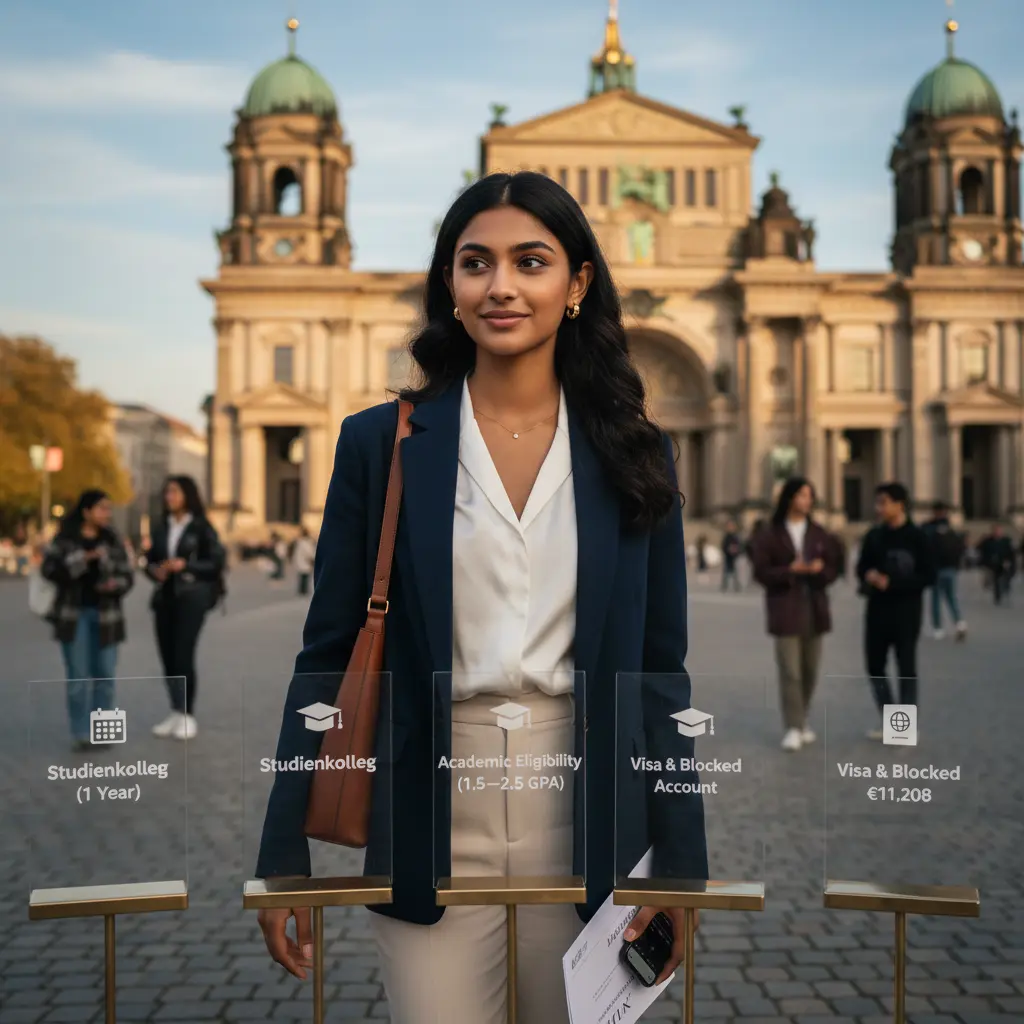
Master’s in Germany After Rejection: The Kiel University Story


Estimated reading time: 7 minutes
Pursuing a Master’s in Germany after rejection is not the end of the road. For Vishal Gupta, a B.Tech Computer Science graduate from Lovely Professional University in Punjab, it was the beginning of a better strategy.
With a 7.11 CGPA and a 6-band IELTS score, Vishal didn’t have the profile that German universities typically fast-track. No IIT or NIT pedigree. No research publications. Not even internships at well-known firms. However, what he did have was something far more important: the willingness to understand why he failed, and to try again the right way.
This is that story.
Four Rejections from Four German Universities
Vishal applied independently for the Winter Semester 2024/25. The results, unfortunately, were consistent.
Brandenburg University of Technology (BTU) rejected his application to the Master’s in Artificial Intelligence. Their portal was blunt: the formal check was complete, the subject-related examination was complete, and the outcome was a rejection. The specific reason stated was that Vishal’s submitted documents showed insufficient knowledge in one or more of the subject areas of computer science, mathematics, and ethics, as required under the Examination and Study Regulations.
Anhalt University of Applied Sciences rejected his application to the Electrical and Computer Engineering program. Their letter, dated July 30, 2024, stated that based on the documents submitted, the selection committee concluded that he did not meet the requirements for admission to the degree program.
University of Passau rejected his application to the Master’s in Computer Science on July 16, 2024. The rejection was particularly instructive: their examination board found that his application did not meet the minimum requirement of 110 ECTS credits in Computer Science, a hard threshold under their Faculty of Computer Science and Mathematics admission regulations.
University of Bamberg rejected his application to the Master’s in International Information Systems Management on August 19, 2024. In addition to the GPA requirement of 2.7 or better, their letter noted that his application was incomplete, which meant he could not even be fully considered on merit.
Four universities. Four rejections. Each for a slightly different reason, but all pointing to the same underlying problem: the applications had not been built with a precise understanding of what each university actually required.
The Question Vishal Asked That Most Students Don’t
At this point, many students quietly give up on Germany. They assume their CGPA is the problem, or their college tier, or their IELTS band. As a result, they either apply to an entirely different country or abandon postgraduate plans altogether.
Vishal, however, came back to Bluehawks EduAbroad with his rejection letters in hand and asked a more productive question: What specifically went wrong, and can it be fixed?
That shift in thinking made all the difference.
What the Rejection Letters Actually Revealed
After reviewing everything Vishal submitted, including two versions of his resume, multiple SOP drafts, and all four rejection letters, a clear pattern emerged.
First and foremost, the university selection had not been done with profile compatibility in mind. The Passau rejection, for instance, cited a specific ECTS threshold in Computer Science. This is a technical requirement that can be anticipated and addressed before applying, not discovered after a rejection arrives in your inbox. Similarly, the Bamberg rejection pointed to an incomplete application. That is not a profile problem. That is a process problem.
Furthermore, the SOPs Vishal had written were structured for a UK or US audience. They emphasized personal motivation and career goals. German admissions committees, by contrast, are looking for academic alignment: evidence that your prior coursework maps onto the specific modules of their program. Without that alignment being made explicit, even a technically solid candidate reads as a weak fit.
Beyond that, there was no cover letter included in any of the applications. In German university submissions, a well-structured cover letter often sets the tone for how the rest of the application is read.
In short, the rejections were not a verdict on Vishal’s potential. They were a verdict on how his potential had been presented.
Rebuilding the Strategy
Vishal formally enrolled in Bluehawks EduAbroad’s Professional Consultancy Services. Rather than rushing into new applications, we started by building the foundation correctly.
To begin with, we conducted a detailed profile evaluation against German Computer Science admission criteria, not just GPA benchmarks, but ECTS credit distributions, course-level relevance, and how Vishal’s technical coursework from LPU could be mapped to the curricula of target programs.
Subsequently, we identified universities where his profile had a genuine, realistic chance, specifically programs where his coursework in data structures, algorithms, operating systems, and database management would count as meaningful preparation rather than a gap.
Following that, we rebuilt every document from scratch. His SOP was restructured to speak the language German admissions committees expect: module-to-module alignment, academic intent, and disciplinary depth. A formal, precisely written cover letter was added for the first time. His resume was reorganized to lead with technical coursework and relevant projects rather than generic achievements.
The goal, ultimately, was not to make Vishal look better on paper. It was to make sure that what was already strong about his profile was visible and legible to the people evaluating it.
The Email from Kiel
Not long after, an email arrived from Christian-Albrechts-Universität zu Kiel, commonly known as Kiel University.
It was not a straightforward offer of admission. Instead, it was something more meaningful for someone in Vishal’s position.
“Dear Vishal Gupta, your application does not fulfill the requirements to be admitted directly to our Master’s program. The interview is intended to test your suitability for our Computer Science program and if you pass it you will be admitted to enroll in the program. The appointment assigned to you is fixed and cannot be rescheduled.”
Max Kasperowski, on behalf of the Kiel University Admissions Team
Kiel had reviewed his profile and decided he was not an automatic admit. Nevertheless, they found him worth a conversation. They invited him to a 20 to 30 minute oral interview on March 12, 2025, focused on mathematics, programming, and software development. As a preparation reference, they pointed to Mathematics for Computer Science by Lehman, Leighton, and Meyer, particularly Part I and the opening chapters of the remaining sections.
This conditional interview pathway is something Kiel specifically offers to applicants whose profiles are serious but not immediately qualifying. Most students either don’t encounter it or don’t treat it with the seriousness it deserves.
Vishal treated it with complete seriousness.
The Interview
Over the following weeks, our experts helped him prepare methodically. He worked through the core mathematical foundations: logic, number theory, proofs, and graph theory. He revisited fundamental programming concepts and software engineering principles, the exact areas Kiel had flagged.
On March 12, 2025, he sat the online interview alone, as required, with his webcam on and his official ID verified.
Within a week, the result arrived.
Vishal Gupta had been admitted to the Master’s program in Computer Science at Kiel University. And today, he is there, studying in Germany.
What This Story Proves About Pursuing a Master’s in Germany After Rejection
It is worth being direct about what changed and what did not.
Vishal’s CGPA did not improve. His IELTS score did not change. His undergraduate college remained the same institution it always was. None of the surface-level markers shifted.
What changed was the precision of the strategy: which universities were targeted, how the documents were structured, and how carefully the specific admission requirements of each program were addressed before submission.
The Passau rejection happened because a hard ECTS threshold was not met on paper. The Bamberg rejection happened partly because the application was incomplete. The BTU rejection pointed to gaps in how subject knowledge was demonstrated. Each of these was, to a significant degree, a preventable outcome.
Germany’s admissions process is more exacting than most. It is document-centric, curriculum-focused, and less forgiving of generic materials than UK or US universities tend to be. Consequently, applicants who treat it like any other international application process often pay for that assumption with rejections that could have gone differently.
A Note for Students in a Similar Position
If you are currently navigating a Master’s in Germany after rejection, the most important thing to understand is that rejections do not automatically mean your profile is insufficient. Often, they mean your application was not built for the specific requirements of the programs you targeted.
A 7.11 CGPA from a private university without a flagship college background is not a disqualification. However, it does mean you have very little margin for error in documentation, university selection, and alignment. Every part of the application has to work harder than it would for a candidate with a stronger academic record from a more recognized institution.
The good news is that some German universities, including Kiel, have structured pathways for candidates who are not automatic admits. If your fundamentals are solid, an interview is not a rejection. It is an opportunity. The question is simply whether you are prepared to take it seriously.
Vishal is currently studying in the Master’s program in Computer Science at Kiel University. If you are planning a Master’s in Germany after rejection and want an honest review of your profile and options, we are happy to help.
🙋♂️ Chat with our 24/7 support team! Just tap the WhatsApp button in the bottom right corner ↘️🟢
Related Links

The Bluehawks Editorial Team is a collaborative group of study-abroad specialists, counselors, researchers, and content experts dedicated to delivering accurate, practical, and up-to-date guidance for students planning to study overseas. Our content combines real-world experience, verified information, and deep insights into global education systems, admissions processes, visas, scholarships, and career pathways.
We create clear, student-focused resources designed to simplify complex decisions and help you explore the best opportunities across top study destinations. From application strategies to post-study outcomes, our goal is to provide trustworthy, transparent, and actionable information to support you at every step of your international education journey.