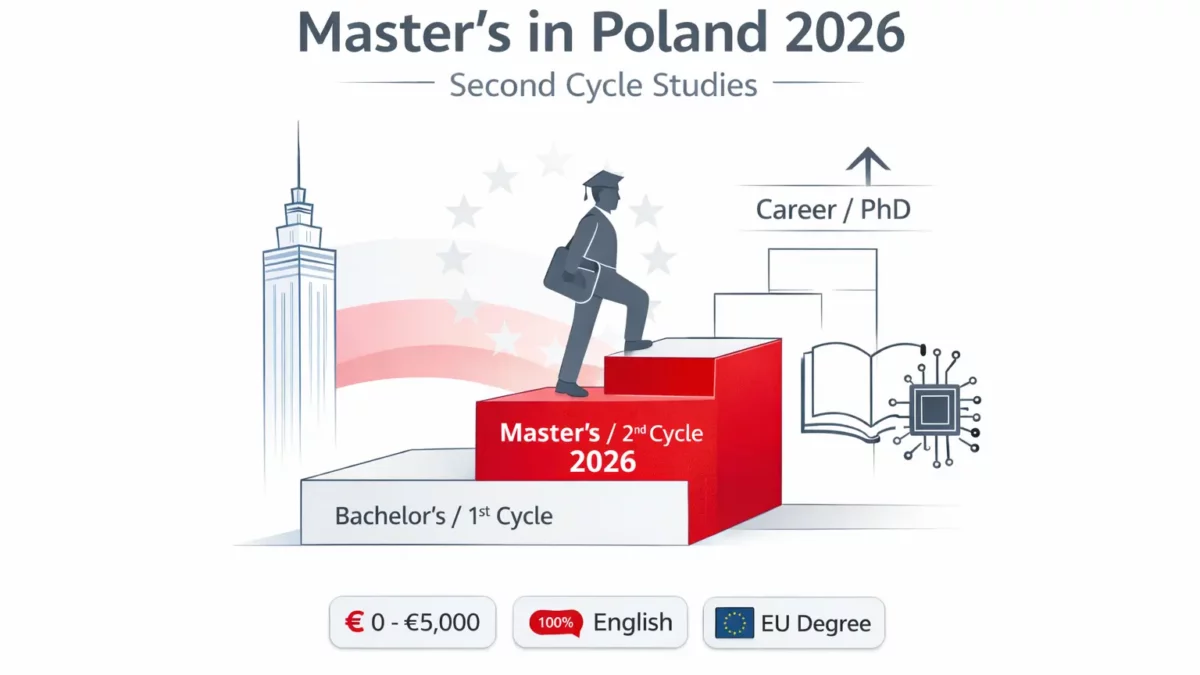
Master’s in Poland 2026: Second Cycle Studies
Estimated reading time: 4 minutes
Poland has quietly moved from being a “backup Europe option” to a structured, regulated, and competitive destination for international students. For the 2026 intake, applying for a Master’s degree (Second Cycle Studies) in Poland is no longer casual—it requires document readiness, academic alignment, and procedural accuracy.
This guide explains how Master’s admissions in Poland actually work in 2026, what Indian students must prepare before applying, and where most applicants go wrong.
Table of contents
- What Is Second Cycle Studies in Poland?
- What Students Must Prepare Before Applying (2026 Update)
- Application & Selection Process in Polish Universities
- Entrance Exams in Poland: What Changed After 2024
- English Proficiency: More Than Just IELTS Scores
- Top Universities in Poland for Master’s (Field-Wise Snapshot)
- Visa Trends for Poland (2026 Reality)
- Common Mistakes Indian Students Make
- Is Poland the Right Choice for Your Master’s in 2026?
- What’s The Way Ahead?
- Why Bluehawks Approach Is Different (And Why It Matters)
What Is Second Cycle Studies in Poland?
In Poland, a Master’s degree is officially known as Second Cycle Studies.
- Open only to students who have completed a recognized Bachelor’s degree
- Typically 1.5 to 2 years
- Taught in English or Polish, depending on the program
- Governed by national and EU academic recognition frameworks
👉 Admission decisions are based on degree equivalence, subject compatibility, and entrance assessments, not just marks.
What Students Must Prepare Before Applying (2026 Update)
1. Academic Documents & Apostille (Mandatory)
Before you even shortlist universities, you must have:
- Final Degree Certificate
- Complete Academic Transcript (all semesters)
Both documents must be apostilled by the
Ministry of External Affairs.
Apostille Routes
- Online (e-Sanad) – Faster, transparent, preferred
- Manual – Via MEA-empanelled service providers (used when online submission isn’t possible)
⚠️ 2026 reality:
Many Polish universities now screen apostilled documents at the application stage itself. Applications without apostille may be put on hold or rejected as incomplete.
2. NAWA Recognition Statement (No Longer Optional)
The NAWA recognition statement is issued by
NAWA.
It confirms that your Indian Bachelor’s degree:
- Is recognized in Poland
- Makes you eligible for Second Cycle Studies
What changed for 2026
- More public universities ask for NAWA before issuing final offers
- Visa officers increasingly cross-verify NAWA status
- Degrees from distance, accelerated, or interdisciplinary backgrounds face higher scrutiny
👉 Treat NAWA as a standard requirement, not a formality.
Application & Selection Process in Polish Universities
The Polish admission process is structured and sequential:
- Online Application Submission
- Apostilled documents
- Academic CV
- Statement of Purpose
- Academic Evaluation
- Subject relevance
- Credit (ECTS) mapping
- Entrance Exam / Interview
- Conditional or Final Offer
- Tuition Fee Deposit
- Visa Process
Unlike earlier years, offers are no longer issued casually. Universities are careful about whom they admit.
Entrance Exams in Poland: What Changed After 2024
Entrance exams are now serious academic filters, not formalities.
Fields Commonly Requiring Exams
- Computer Science / IT / AI
- Data Science
- Engineering
- Psychology
- Select Management programs
Exam Format (2026)
- Online, timed assessments
- Sometimes proctored
- Clear cut-offs, not pass/fail
👉 For 2026, entrance exam preparation matters as much as an outstanding IELTS Score.
English Proficiency: More Than Just IELTS Scores
Having IELTS is not always enough.
What universities and visa officers now assess:
- Spoken academic English during interviews
- Ability to explain:
- Your bachelor’s subjects
- Why you chose the program
- Your post-study plan
Low IELTS + weak speaking skills = higher rejection risk, even with an offer.
Top Universities in Poland for Master’s (Field-Wise Snapshot)
Computer Science, IT & Engineering
Warsaw University of Technology
AGH University of Science and Technology
Wroclaw University of Science and Technology
Business, Economics & Management
University of Warsaw
Kozminski University
SGH Warsaw School of Economics
Life Sciences, Biotechnology & Chemistry
Jagiellonian University
Poznan University of Life Sciences
Visa Trends for Poland (2026 Reality)
Earlier, Poland was known for visa waivers or minimal interviews. That has changed.
Current trends:
- More students are called for short visa interviews
- Officers focus on:
- Course relevance
- Why Poland over Germany or Ireland
- Financial transparency
- Post-study intent
Financial Documentation
- Tuition + living funds must be clearly traceable
- Sudden large deposits raise red flags
- Loan sanction letters are preferred over affidavits
Common Mistakes Indian Students Make
- Applying without apostille
- Treating NAWA as optional
- Choosing a Master’s unrelated to Bachelor’s background
- Ignoring entrance exam preparation
- Assuming Poland is “easy Europe”
These mistakes cost intakes, not just time.
Is Poland the Right Choice for Your Master’s in 2026?
Poland makes sense if you:
- Have clear academic continuity
- Want EU-recognized education at reasonable cost
- Are ready for entrance exams and interviews
Poland may not suit you if you:
- Are looking for a shortcut into Europe
- Want zero academic scrutiny
- Are changing fields without justification
What’s The Way Ahead?
For the 2026 intake, Poland is structured, selective, and compliance-driven.
Students who prepare documents early, respect academic alignment, and understand the process do very well. Those who rush or assume flexibility often lose an entire year.
Admission requirements can vary by university and intake. Students should always verify program-specific criteria before applying.
Why Bluehawks Approach Is Different (And Why It Matters)
Most traditional, old-school study abroad consultants still operate on assumptions from pre-2022 Europe—when Poland was document-light, NAWA was ignored, and academic relevance was loosely enforced. That reality no longer exists.
Our approach to Master’s in Poland 2026 is fundamentally different:
- We start with eligibility and degree alignment, not university names
- Apostille and NAWA are treated as foundational steps, not afterthoughts
- Entrance exams and interviews are prepared for, not brushed aside
- Financials and visa intent are built to be clear, traceable, and defensible
Instead of pushing applications blindly, we focus on process correctness, compliance, and clarity—so students don’t lose time, money, or an entire intake due to avoidable mistakes.
For students who want a stress-free, reliable, and well-structured Poland study abroad experience, this method removes uncertainty and replaces it with confidence at every stage—from documents to admission to visa.
🙋♂️ Chat with our 24/7 support team! Just tap the WhatsApp button in the bottom right corner ↘️🟢