SX-1 Visa refusal Canada


Estimated reading time: 14 minutes
Getting an SX-1 Visa refusal for Canada can feel like a door slamming shut. You had your course lined up, your documents ready, and now there is a rejection letter sitting in your inbox.
Here is the truth: a refusal is not the end of your Canada plans. Most SX-1 rejections happen for fixable reasons, and thousands of Indian students reapply successfully every year once they understand what went wrong and how to fix it.
This guide walks you through every step, from reading your refusal letter correctly to building a stronger reapplication. If you have not yet applied and want to understand how the SX-1 Visa works, start with our main guide: SX-1 Visa for Canada. Come back here if you face a refusal.
Table of contents
- First: What an SX-1 Visa Refusal Actually Means
- Step 1: Read Your Refusal Letter Carefully
- The Most Common Reasons for an SX-1 Visa Refusal
- Step 2: Request Your GCMS Notes (If You Need More Detail)
- Step 3: Do Not Reapply Immediately
- Step 4: Build a Stronger Reapplication
- Step 5: Consider Whether the SX-1 Route is Still Right for You
- Can You Appeal an SX-1 Visa Refusal?
- Does an SX-1 Refusal Affect Other Country Visa Applications?
- Frequently Asked Questions About SX-1 Visa Refusals
- Final Thoughts
First: What an SX-1 Visa Refusal Actually Means
An SX-1 Visa refusal means the immigration officer who reviewed your application was not satisfied that you met the requirements to enter Canada as a short-term student. It does not mean you are permanently barred from Canada. It does not mean you are a dishonest applicant. It simply means your application, as submitted, did not convince the officer on one or more specific points.
The refusal is recorded in your IRCC file. You must declare it honestly in all future Canadian visa applications. Hiding a prior refusal is treated as misrepresentation, which is far more serious than the refusal itself and can lead to a multi-year ban.
A refusal is a redirection, not a rejection of you as a person. Many students who faced SX-1 refusals have gone on to study in Canada, often with stronger applications that got approved on the second attempt.
Step 1: Read Your Refusal Letter Carefully
Your refusal letter is the most important document you have right now. Do not skim it or set it aside in frustration. Read it word by word.
The letter will state the specific grounds on which you were refused. These are usually written in formal language, but they point directly to what the officer felt was missing or unconvincing in your application. Common phrases you might see include:
- Not satisfied that you will leave Canada at the end of your authorised stay
- Insufficient financial resources to cover your stay
- Purpose of visit not established
- Inconsistency between stated purpose and supporting documents
- Medical inadmissibility
- Criminal inadmissibility
Each of these phrases maps to a specific problem you can address. We go through each one in detail in the next section.
One important update for 2026: IRCC now proactively includes officer decision notes with TRV refusal letters. This means you will receive more detail about the officer’s reasoning directly with the refusal, without needing to file a separate GCMS request first. Read both documents together before deciding your next step.
The Most Common Reasons for an SX-1 Visa Refusal
1. Weak Ties to Your Home Country
This is the single most common reason for SX-1 Visa refusals from India. The officer needs to believe, based on evidence, that you will return to India after your course ends. If your application does not clearly show what is pulling you back home, the officer may conclude you are a potential overstay risk.
What counts as strong home ties:
- An employment letter from your Indian employer confirming leave approval and that your job is waiting for you
- Proof of property ownership in India (land, flat, commercial property)
- Bank fixed deposits or investments in India
- Immediate family dependents in India (spouse, children, parents you support)
- An ongoing business registration in India
The more of these you can show, the better. A single bank statement is rarely enough on its own. Build a package.
2. Insufficient Financial Proof
The officer needs to see that you have enough money to pay for your course, live in Canada for the duration, and travel back home without needing to work. If your bank statements are thin, recently topped up, or inconsistent with your declared income, the officer will flag this.
Common financial red flags that lead to refusals:
- Bank balance that suddenly spiked just before the application date
- Statements showing only the last one or two months instead of four to six months
- Balance that barely covers tuition with nothing left for living costs
- Funds from a third party with no clear explanation of the relationship
What to fix: Submit six months of statements showing a stable, consistent balance. Add a fixed deposit certificate if you have one. If a family member is sponsoring you, include their bank statements and a notarised sponsor letter explaining their relationship to you and their willingness to fund your trip.
3. Weak or Vague Statement of Purpose (SOP)
The SOP is where you explain why you want to study this specific course in Canada, how it connects to your career in India, and why you are choosing Canada over studying the same subject in India. If your SOP is generic, copied from a template, or fails to make a logical connection between the course and your career plans back home, it will hurt your application. Learn more about how to write SOP for study abroad
A strong SOP for an SX-1 application needs to answer four questions clearly:
- What course are you taking and at which institution?
- Why does this specific course require you to physically be in Canada?
- How does completing this course help your career or business in India?
- Why will you return to India after the course ends?
4. Incomplete or Incorrect Documents
Something as simple as a missing page in your bank statement, an expired police clearance certificate, or an unsigned sponsor letter can be enough to trigger a refusal. Officers do not chase you for missing documents. They simply refuse.
Before reapplying, go through your previous document set and check for:
- Bank statements that are unsigned, undated, or missing pages
- Letter of Acceptance (LOA) that does not clearly state the course duration
- Medical exam results from a non-approved physician or that have expired
- Passport photos that do not meet IRCC specifications
- Any form that was left partially blank
5. Inconsistency Between Documents
If your SOP says you work as a marketing manager but your bank statements show income from a different source, or if your employer letter states different dates than what you mentioned in the form, the officer will notice. Any mismatch across documents raises credibility concerns even if each document individually looks fine.
Before submitting, read all your documents side by side and make sure the story they tell is consistent throughout.
6. Wrong IRCC Portal Selection
This is a purely technical error but it causes real refusals. If you selected Study instead of Visit on the IRCC portal, you would have been assessed for a full Study Permit, not an SX-1. Or if you selected Visit but did not mention short-term study as your purpose, you may have been issued a standard tourist visa code (V-1) instead of SX-1, which does not authorise study.
Always select Visit, then Short-term study (course less than 6 months) on the portal. This is the only combination that correctly flags your application for SX-1 processing.
7. Poor or No Travel History
First-time international travellers with no prior visa approvals from any country face higher scrutiny. It does not mean you will be refused, but it means your other documents need to be significantly stronger to compensate. If you have prior visas, US, Schengen, UK, Australia, include those passport pages even if the visas have expired.
8. Medical or Security Inadmissibility
If your medical examination flagged a health condition that could place excessive demand on Canadian health services, or if your police clearance revealed a criminal record, your application may be refused on inadmissibility grounds. These cases are more complex and usually require professional immigration advice before reapplying.
Step 2: Request Your GCMS Notes (If You Need More Detail)
Your refusal letter and the officer decision notes that now accompany it will give you a reasonable picture of what went wrong. In most cases, that is enough to identify the problem and fix it.
However, if you want the complete internal record of how the officer assessed your file, including every note they entered into IRCC’s system, you can request your GCMS notes through an ATIP (Access to Information and Privacy) request.
Who can file the ATIP request?
You cannot file the request yourself from India. Only Canadian citizens, permanent residents, or individuals physically present in Canada can submit an ATIP request. If you do not have anyone in Canada, some registered immigration consultants (RCICs) and immigration lawyers in Canada offer this as a paid service.
If you have a friend or relative in Canada who is a citizen or permanent resident, they can file on your behalf. You will need to sign Form IMM5477 (Consent for an Access to Information and Personal Information Request) and send it to them.
How much does it cost and how long does it take?
The ATIP request fee is CAD 5. Processing typically takes 30 days, though it can occasionally take longer. The notes are usually delivered by email as a PDF.
What will you receive?
The GCMS notes are usually 30 to 50 pages long. Most of it is administrative. What you are looking for is the officer’s electronic notes, which are typically in the last few pages. These will show you the exact language the officer used when assessing your application, which is far more specific than the refusal letter.
Requesting GCMS notes does not affect your current or future applications in any way. It is simply accessing your own file under Canadian privacy law.
Step 3: Do Not Reapply Immediately
This is one of the most common mistakes students make after an SX-1 Visa refusal. The urge to submit a new application right away is understandable, but reapplying with the same documents, or with only minor changes, almost always results in another refusal.
IRCC officers can see your previous application and the prior refusal. If they see that nothing substantial has changed, they have no reason to reach a different conclusion.
Before reapplying, you need to have genuinely resolved the specific issue that caused the refusal. This might take a few weeks or a few months depending on what needs to change.
| Refusal Reason | Minimum Recommended Wait | What to Do Before Reapplying |
| Weak home ties | 4 to 8 weeks | Gather employment letter, property docs, family affidavit |
| Insufficient funds | 2 to 3 months | Build 6 months of consistent bank statements |
| Weak SOP | 2 to 4 weeks | Rewrite SOP from scratch with specific career rationale |
| Incomplete documents | 1 to 2 weeks | Rebuild complete document set and cross-check everything |
| Medical inadmissibility | Varies | Consult an RCIC or immigration lawyer first |
| Wrong portal selection | 1 to 2 weeks | No wait needed, just apply correctly this time |
Step 4: Build a Stronger Reapplication
A successful reapplication is not just a repeat of your original application with one or two documents added. It is a completely rebuilt case that directly addresses the refusal reason and removes any room for doubt.
Strengthening Your Home Ties Package
Think of this as a file, not a single document. Aim to include as many of the following as apply to your situation:
- Employment letter on company letterhead, signed by HR or your manager, confirming your role, salary, approved leave dates, and that your position will be held for you
- Last three months of salary slips
- Property documents (title deed, registered sale deed, or municipal tax receipt)
- Fixed deposit or investment account statements
- Family ties evidence (birth certificate of children, marriage certificate, proof of financially dependent family members)
- Business registration certificate if you run your own business
Strengthening Your Financial Documents
- Six months of bank statements with a clear, consistent balance pattern
- The balance should comfortably cover tuition plus at least CAD 1,000 to CAD 1,500 per month for living costs for your entire stay
- If a family member is sponsoring you, include their six-month bank statements plus a notarised sponsorship letter
- Avoid large, unexplained cash deposits just before submitting
- A fixed deposit certificate adds credibility as it shows stable, parked funds rather than flowing transaction money
Rewriting Your Statement of Purpose
Do not reuse your previous SOP. Write it fresh. Be specific, direct, and honest. A good SOP for an SX-1 reapplication should:
- Acknowledge the previous refusal and briefly explain what has changed
- Name the exact course, its duration, and the institution offering it
- Explain why this course specifically requires being in Canada physically and cannot be done online from India
- Show a clear connection between the course and your current or planned career in India
- Explain what is waiting for you in India when you return
Disclosing the Prior Refusal
The application form will ask whether you have ever been refused a visa to Canada or any other country. Answer honestly. If you lie and it is discovered, you will be found guilty of misrepresentation, which can result in a ban of up to five years from all Canadian immigration pathways.
Disclosing a prior refusal does not automatically disqualify you. Officers understand that people reapply and that circumstances change. What matters is that your new application is materially stronger than the one that was refused.
Step 5: Consider Whether the SX-1 Route is Still Right for You
After a refusal, it is worth pausing to ask whether the SX-1 Visa is still the right option for your situation. In some cases, a different approach makes more sense.
| Situation | Recommended Next Step |
| Course can be extended beyond 6 months | Apply for a full Study Permit (S-1) from the start |
| You need to work part-time while studying | Apply for a Study Permit (S-1) which may allow off-campus work |
| Multiple SX-1 refusals with the same reason | Consult a Regulated Canadian Immigration Consultant (RCIC) |
| Medical or criminal inadmissibility | Legal advice before any reapplication |
| Course is at a non-DLI institution | Check if switching to a DLI-recognised institution is possible |
Can You Appeal an SX-1 Visa Refusal?
There is no direct appeal process for an SX-1 Visa refusal. Unlike some other immigration decisions, you cannot ask IRCC to reconsider the same application. Your options are:
- Reapplication: Fix the issues and submit a new, stronger application. This is the standard route for most students.
- Judicial Review: You can apply to the Federal Court of Canada for a judicial review if you believe the process was procedurally unfair, for example, if the officer failed to consider evidence you submitted. This is rare, expensive, and requires a Canadian immigration lawyer. It does not guarantee approval, only a fresh assessment.
- Switching visa category: If your situation genuinely fits a full Study Permit rather than SX-1, applying for an S-1 Study Permit instead may be more appropriate.
Does an SX-1 Refusal Affect Other Country Visa Applications?
Some countries, including the United States, United Kingdom, and Australia, ask whether you have ever been refused a visa to Canada or any other country in their application forms. You must disclose your SX-1 refusal honestly when asked.
A single refusal, properly disclosed and with a credible explanation, rarely causes problems for applications to other countries. What causes problems is hiding a refusal and having it discovered later.
Frequently Asked Questions About SX-1 Visa Refusals
There is no mandatory waiting period, but reapplying immediately without fixing the underlying issue is almost always a waste of time and fees. Take the time to genuinely address the refusal reason before submitting again.
It depends on what caused the refusal. For document issues, a couple of weeks may be enough. For financial issues, you may need two to three months to build up a credible bank statement history. For home ties issues, gathering all the right documents typically takes four to eight weeks.
Yes. Every IRCC officer who processes your reapplication can see your prior refusal on your file. This is why your reapplication must be noticeably stronger and must clearly address the prior concern.
For most students, a carefully rewritten SOP is sufficient. Focus on being specific, direct, and connecting the course clearly to your career back in India. If you have faced multiple refusals or your situation is complicated, a consultation with a reputed consultant like Bluehawks Edu is worth considering.
Yes. We work with students who have faced visa refusals as part of our regular consulting. We review your refusal letter, help identify what needs to change, and help you build a stronger application. Our model is student-first and non-commission, so our advice is based entirely on your situation. Reach out for a consultation.
Two refusals for the same reason are a clear signal that your approach needs a significant change. At this point, professional consultation is strongly recommended. An RCIC or immigration lawyer can review your GCMS notes and advise whether reapplying under SX-1, switching to a Study Permit, or taking a different route altogether is the right move.
Final Thoughts
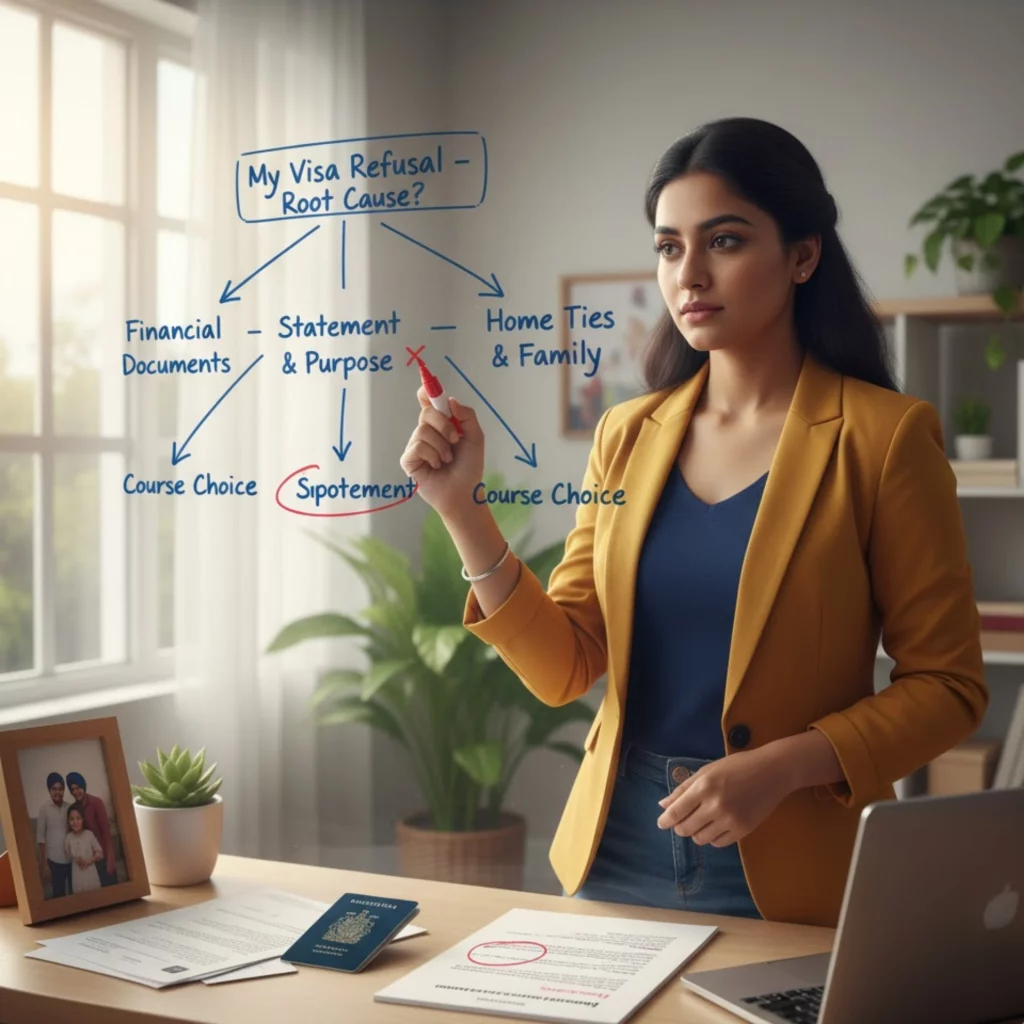
An SX-1 Visa refusal is frustrating, but it is not unusual and it is definitely not permanent. The majority of refusals come down to three things: weak home ties, thin financial proof, or a vague Statement of Purpose. All three are fixable.
What does not work is reapplying quickly without making meaningful changes. What does work is taking the time to understand exactly what the officer was not satisfied with, addressing it directly, and presenting a stronger, more complete picture of your situation.
If you need help making sense of your refusal or putting together a stronger reapplication, we are here. At Bluehawks Edu, we have helped students navigate exactly this kind of situation since 2016, without any commission-driven agenda.
? Chat with our 24/7 chat support team, just tap on that WhatsApp button on the right bottom of your screen ?
Also read: SX-1 Visa for Canada: Eligibility, Application and Everything You Need to Know (2026)

The Bluehawks Editorial Team is a collaborative group of study-abroad specialists, counselors, researchers, and content experts dedicated to delivering accurate, practical, and up-to-date guidance for students planning to study overseas. Our content combines real-world experience, verified information, and deep insights into global education systems, admissions processes, visas, scholarships, and career pathways.
We create clear, student-focused resources designed to simplify complex decisions and help you explore the best opportunities across top study destinations. From application strategies to post-study outcomes, our goal is to provide trustworthy, transparent, and actionable information to support you at every step of your international education journey.