F-1 Visa Refusal Reasons Explained: Country-Wise Analysis
Estimated reading time: 5 minutes
A common assumption among students and parents is that F-1 visa refusals are largely an India-specific problem. This belief often leads to misplaced confidence or unnecessary anxiety.
The reality is different.
F-1 visa refusal reasons exist across the world, affecting applicants from Asia, Africa, Europe, the Middle East, and Latin America. What varies is not the law, but how risk is interpreted based on country-specific patterns.
This article explains:
- Why F-1 visa refusals are a global phenomenon
- What remains constant under U.S. immigration law
- How F-1 visa refusal reasons vary by country
- What students can realistically do to reduce risk
The intent is clarity, not alarm.
Table of contents
The Law Behind Every Decision: INA 214(b)
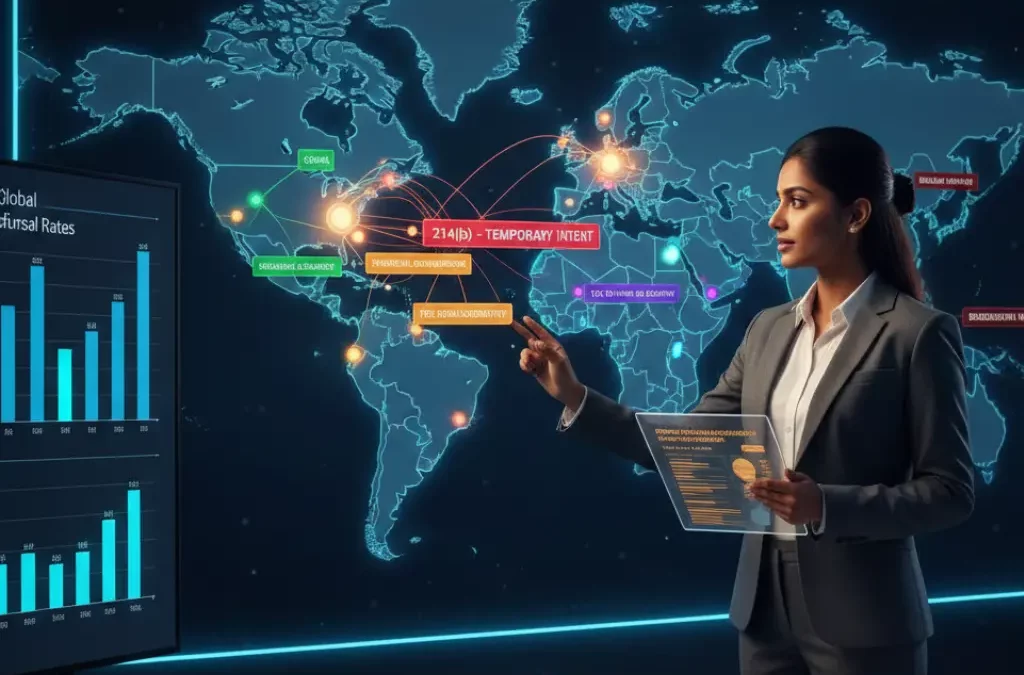
All F-1 visa decisions are governed by Section 214(b) of the U.S. Immigration and Nationality Act.
Under this provision:
- Every applicant is presumed to be an intending immigrant
- The burden of proof lies with the student
- Approval depends on demonstrating temporary intent, not just academic eligibility
This legal framework applies equally to all nationalities.
However, how officers assess F-1 visa refusal reasons depends heavily on context, experience, and historical data.
Why F-1 Visa Refusal Reasons Differ by Country
Although the law is uniform, consular officers operate in vastly different environments. Their assessments are influenced by:
- Historical overstay and status-violation trends
- Applicant volume from a particular country
- Financial transparency norms
- Employment and migration pressure
- Geopolitical or security considerations
These factors explain why F-1 visa refusal reasons vary by country, even when two applicants may appear similar on paper.
Country-Wise F-1 Visa Refusal Reasons
🇮🇳 India
India sends one of the largest student populations to the U.S., which results in pattern-based scrutiny.
Common F-1 visa refusal reasons
- Generic MS narratives, particularly in CS and Data Science
- Heavy reliance on education loans without strong family financial backing
- Inability to justify the choice of university clearly
- Overemphasis on OPT, salaries, or long-term stay
- Reapplications without meaningful narrative correction
These patterns form some of the most common F-1 visa refusal reasons for Indian students—not due to lack of merit, but lack of clarity.
🇨🇳 China
Chinese applicants often have strong academic credentials, yet refusals are not uncommon.
Common F-1 visa refusal reasons
- Research areas linked to sensitive technologies (AI, robotics, aerospace)
- Affiliations with government or military-linked institutions
- Ambiguity around research intent or future application
- Incomplete disclosure of funding or institutional ties
Here, national security concerns often outweigh academic strength when F-1 visa refusal reasons are evaluated.
🇳🇬 Nigeria
Nigeria is a high-scrutiny country due to historical patterns of misuse.
Common F-1 visa refusal reasons
- Unclear or unverifiable sources of funds
- Sponsors lacking documented income credibility
- Weak academic progression logic
- Limited professional or family anchors at home
In many Nigerian cases, financial credibility directly influences perceived intent.
🇧🇩 Bangladesh
Bangladeshi applicants face intense evaluation of return likelihood.
Common F-1 visa refusal reasons
- Heavy dependence on third-party sponsors
- Limited local career pathways post-study
- Inconsistent academic performance
- Weak linkage between U.S. education and home-country employment
Officers often assess whether the education plan genuinely supports reintegration.
🇵🇰 Pakistan
Pakistani applicants are assessed through a dual lens of intent and security.
Common F-1 visa refusal reasons
- Security-related administrative concerns
- Weak justification for choosing the U.S. over regional alternatives
- Program level mismatch (overqualification or underqualification)
- Incomplete articulation of long-term goals
Here, clarity and consistency are critical to overcoming refusal risk.
🇳🇵 Nepal
Nepal has seen a noticeable rise in refusals in recent years.
Common F-1 visa refusal reasons
- Unrealistic or poorly explained financial plans
- Generic, copy-paste study plans
- Absence of a convincing post-study pathway within Nepal
- Peer misuse patterns influencing officer perception
In such cases, originality and credibility matter more than documentation.
🇻🇳 Vietnam
Vietnamese applicants generally have solid academics but still face intent scrutiny.
Common F-1 visa refusal reasons
- Immediate family members residing in the U.S.
- Funding sources not clearly articulated
- Weak verbal articulation despite good English scores
- Career plans disconnected from Vietnam’s job market
Family migration history often heightens return-intent concerns.
🇵🇭 Philippines
The Philippines has a strong U.S. diaspora, which impacts visa assessment.
Common F-1 visa refusal reasons
- Close family ties in the U.S.
- Career stagnation despite prior education
- Inconsistent professional narratives
- Weak justification for further overseas study
Officers are cautious about lifestyle-driven migration disguised as education.
Middle East (Iran, Iraq, Syria)
In these regions, refusals often involve procedural complexity.
Common F-1 visa refusal reasons
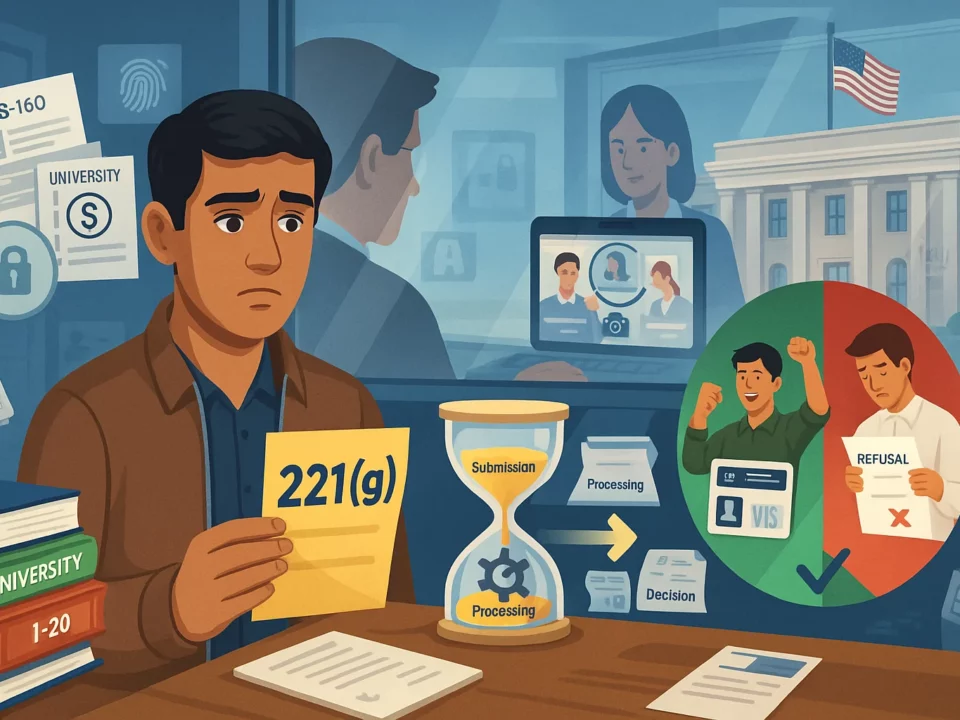
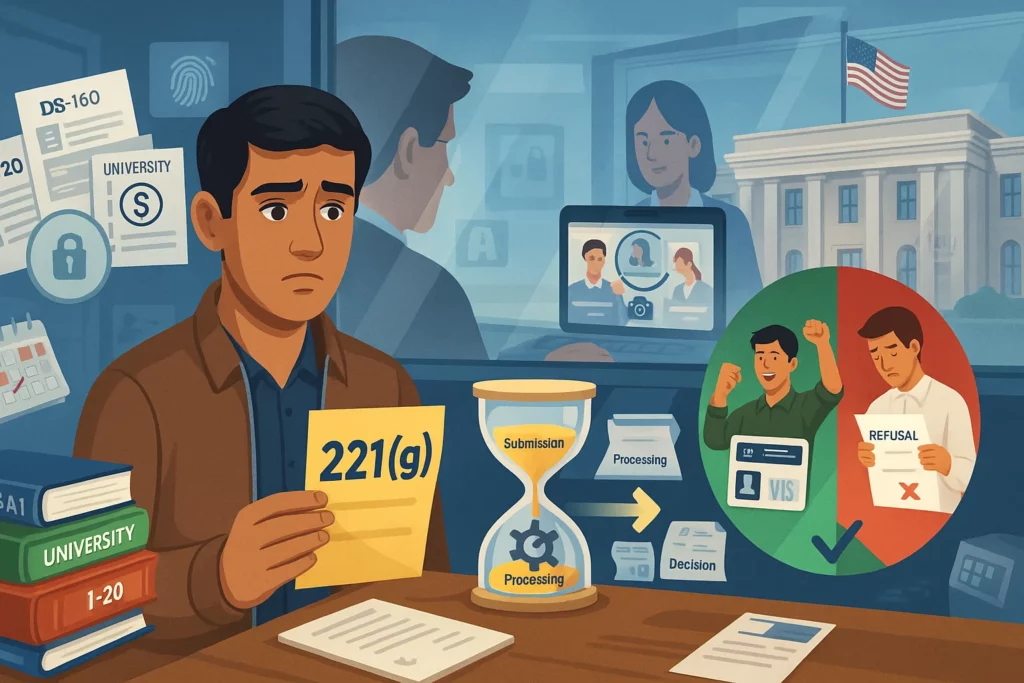
- Prolonged administrative processing (221g)
- Sanctions and compliance checks
- Sensitive research domains
- Ambiguity around funding or affiliations
Here, compliance and security reviews often dominate outcomes.
Europe (Turkey, Russia, Ukraine)
Even applicants from Europe are not immune to refusals.
Common F-1 visa refusal reasons
- Political or military affiliations
- Government-funded education backgrounds
- Career plans misaligned with local opportunities
- Unclear financial pathways
Geopolitical context can influence how risk is assessed.
Latin America (Brazil, Colombia)
In Latin America, intent assessment is often decisive.
Common F-1 visa refusal reasons
- Weak post-study return logic
- Employment gaps
- Overemphasis on U.S. lifestyle advantages
- Poor explanation of program necessity
The distinction between education intent and migration intent is closely examined.
A Reality Many Students Overlook
Across regions, F-1 visa refusal reasons consistently point to credibility gaps, not academic inadequacy.
Refusals are rarely caused by missing documents. More often, they stem from:
- Incoherent career logic
- Inability to explain decisions under time pressure
- Study plans that increase perceived risk
Two applicants with similar profiles can receive different outcomes based purely on how convincingly intent is communicated.
Why Reapplications Fail More Often Than First Attempts
Many students assume a reattempt requires only:
- Additional documents
- A different university
- A new interview slot
In practice, repeated refusals occur because the core F-1 visa refusal reasons from the first attempt remain unaddressed. Without strategic correction, credibility weakens further.
What Students Should Do Differently
Students who succeed across countries typically:
- Build a career-first narrative, not an admission-first one
- Choose programs that clearly extend existing trajectories
- Understand how their country context shapes officer perception
- Prepare responses that reduce risk rather than raise new questions
At bluehawks, patterns across countries consistently show that visa success improves when intent clarity comes before application speed.
Final Perspective
An F-1 visa is not an academic reward.
It is a credibility assessment.
Refusals happen worldwide—not because students are weak, but because F-1 visa refusal reasons are rooted in risk evaluation, not talent measurement.
Understanding this early allows students to approach their U.S. education plans with realism, preparation, and long-term thinking—qualities that matter far more than country labels.
Need help? 🙋♂️ Chat with our 24/7 support team! Just tap the WhatsApp button in the bottom right corner ↘️🟢