F1 Visa Application Process 2026: Step-by-Step Guide for Indian Students


Estimated reading time: 16 minutes
India is the largest source of international students in the United States. In the 2024-25 academic year, Indian students outnumbered every other nationality on American campuses. That position has not changed. What has changed is how difficult the path to getting there has become.
The F1 visa approval rate for Indian students stands at 59% in 2026. That means roughly 4 out of every 10 applicants are refused. Between June and July 2025, the peak booking window for Fall intake, only 12,776 F1 visas were issued to Indian students. The same window in 2024 produced 41,336. That is a 69% drop in a single year, driven by a worldwide pause on new visa interviews, expanded social media screening, and stricter financial scrutiny.
The situation has stabilised heading into the Fall 2026 cycle, but it has not returned to what it was. Mandatory social media disclosure, the elimination of interview waivers, a one-reschedule limit on appointments, and new interview questions added in April 2026 have all changed what a prepared F1 application looks like.
This guide walks through every step of the F1 visa application process for 2026, with the current fees, the new rules, and the specific mistakes that are sending Indian students home with a 214(b) refusal.
Table of contents
- The 2026 US Visa Climate: What Changed and What It Means for You
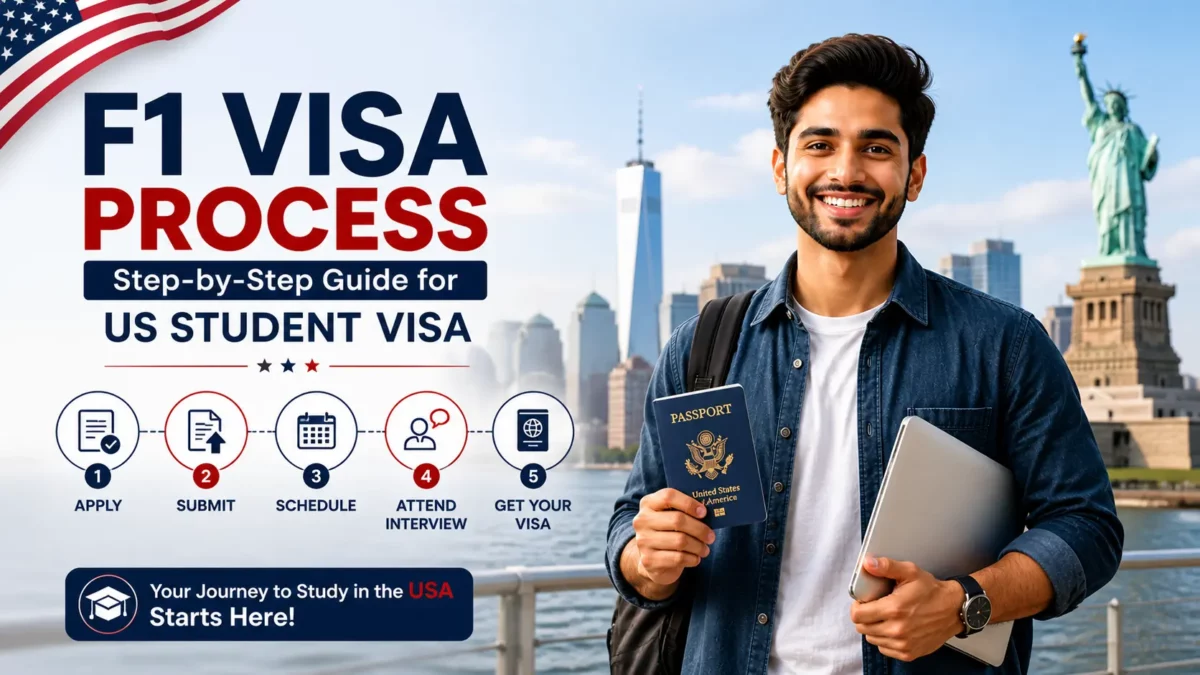
- The F1 Visa Application Process: Eight Steps
- Step 1: Receive and Check Your I-20
- Step 2: Pay the SEVIS I-901 Fee
- Step 3: Complete the DS-160 Form
- Steps 4 and 5: Create Your Profile and Pay the MRV Fee
- Step 6: Book Your VAC and Interview Appointments
- Step 7: Attend Your VAC Appointment
- Step 8: The Visa Interview
- The new 2026 interview questions
- Section 214(b): The Most Common Refusal Reason
- F1 Visa Application Timeline for Fall 2026
- Frequently Asked Questions About the F1 Visa Application Process in 2026
- Final Thoughts
The 2026 US Visa Climate: What Changed and What It Means for You
Understanding the context matters before you start the process. The F1 visa application process in 2026 is more demanding than it was two years ago for three structural reasons that are not going away.
Mandatory social media screening from June 2025
On June 18, 2025, the US State Department announced expanded screening for all F, M, and J visa applicants. Under this policy, all social media accounts must be set to public before your interview. Consular officers review your online presence as part of their assessment. Five years of social media history is subject to disclosure.
What this means practically: anything you have posted about political conflict, safety concerns, or any sentiment that could be read as reluctance to return to India needs to be considered carefully. This is not about political opinion in the abstract. It is specifically about content that could appear inconsistent with a student who intends to study in the US and return home.
Review your social media accounts before you apply. Accounts set to private during the application period can be flagged. Content that contradicts your stated intent to return to India can trigger administrative processing or refusal, regardless of how strong the rest of your application is.
Interview waivers eliminated from September 2025
Until 2025, some categories of F1 applicants, including students reapplying within a certain timeframe, could qualify for an interview waiver. That option was eliminated from September 2025. Every F1 applicant in India now attends an in-person interview. There are no exceptions.
New interview questions from April 2026
On April 28, 2026, the US State Department issued a directive adding two questions to all non-immigrant visa interviews, including F1 student visa interviews:
- Have you experienced harm or mistreatment in your home country?
- Do you have any fear of returning to your home country?
If an applicant answers yes to either question, or declines to answer, the visa is denied under section 214(b). For the overwhelming majority of Indian students going abroad for a legitimate degree, the answer to both questions is simply no. Say it clearly and move on.
The risk is not in the questions themselves. It is in inconsistencies elsewhere in your application. If your SOP describes hardship or discrimination in India, or if your social media content contradicts a confident no, the officer will dig further. We cover this in detail in our dedicated guide. New F-1 Visa Interview Rule in 2026
One free reschedule from January 2026
From January 2026, applicants in India are allowed only one free reschedule of their visa appointment. A second change requires paying the full MRV visa fee of $185 again. This makes it more important than ever to book your slot thoughtfully rather than grabbing the first available date and rescheduling later.
The F1 Visa Application Process: Eight Steps
The steps below are sequential. Most delays happen when students try to run them in the wrong order, or when they rush one step and create an error that blocks the next. Follow them in order.
| Step | Action | Fee (2026) |
| 1 | Accept admission offer and get your I-20 from the university | None |
| 2 | Pay the SEVIS I-901 fee | $350 (~INR 32,800) |
| 3 | Complete the DS-160 form on CEAC | None (fee paid separately) |
| 4 | Create profile on usvisascheduling.com | None |
| 5 | Pay the MRV visa application fee | $185 (~INR 17,300) |
| 6 | Book your VAC (biometrics) and interview appointments | None |
| 7 | Attend VAC appointment | None |
| 8 | Attend visa interview | Decision made same day |
Step 1: Receive and Check Your I-20
The I-20 is the Certificate of Eligibility for Nonimmigrant Student Status. Your university issues it after you accept your offer of admission and complete the financial verification requirements. Without the I-20, you cannot pay the SEVIS fee, cannot complete the DS-160, and cannot book your visa appointment. It is the starting document for everything.
When you receive your I-20, check the following before doing anything else:
- Your full name matches your passport exactly, including spelling and middle name if applicable
- Your date of birth is correct
- The program name and start date are correct
- The SEVIS ID number in the top-left corner is clearly printed
- The document is signed by your university’s Designated School Official (DSO)
- You have signed it yourself
Any error on the I-20 creates a mismatch with your DS-160 and passport. Mismatched details are one of the most common reasons applications are flagged or delayed. If you spot an error, contact your university’s international students office immediately and request a corrected I-20 before proceeding.
Request your I-20 as soon as you accept your offer. Do not wait until you have made travel plans or until closer to your course start date. Everything else in your timeline depends on having this document.
Step 2: Pay the SEVIS I-901 Fee
The SEVIS fee is a mandatory government fee paid to the Student and Exchange Visitor Program (SEVP). It is separate from the visa application fee. You pay it directly on the SEVIS website (fmjfee.com) using the SEVIS ID printed on your I-20.
| Fee Type | Amount | Who Pays |
| F-1 student SEVIS I-901 fee | $350 | All F1 applicants |
| F-2 dependent SEVIS fee | Not required | Dependents do not pay the SEVIS fee separately |
Download and save the payment receipt immediately. You will need it at your VAC appointment, at your visa interview, and again when you enter the United States. Do not lose this document.
The SEVIS fee payment activates your SEVIS record. Without an active SEVIS record linked to your I-20, your visa application cannot be processed.
Step 3: Complete the DS-160 Form
The DS-160 is the online nonimmigrant visa application form, completed at the Consular Electronic Application Center (CEAC) at ceac.state.gov. It is the foundation of your visa application. Every detail on this form will be reviewed by the consular officer at your interview.
What you need before starting
- Your I-20 (for SEVIS ID, program details, and university information)
- Your passport (for personal details, issue date, expiry date)
- SEVIS fee receipt
- Details of your travel plans, entry date, and intended length of stay
- Your last five visits to the US, if any
- Five years of international travel history
- Employment history
- Details of your course, university, and why you chose it
Critical DS-160 rules for 2026
The DS-160 cannot be edited after submission. If you discover an error after submitting, you must start a new DS-160 application. This is a common source of avoidable delays. Take your time and check every field before clicking submit. Learn more about Updating your DS‑160 before and after scheduling appointment
Under the expanded social media screening policy active from June 2025, the DS-160 now includes a mandatory social media disclosure section. You must list all social media platforms you have used in the past five years and your username or handle on each. Omitting accounts you actually use constitutes misrepresentation.
From 2026, your DS-160 must be submitted at least 48 to 72 business hours before your interview appointment. Do not wait until the night before.
The single most common technical error on DS-160 forms from Indian applicants is a name mismatch between the DS-160 and the passport or I-20. Check that your name is spelled identically across all three documents, character by character, including any difference between given name, surname, and middle name fields.
We have a detailed DS-160 guide on the site covering every section in depth. Common Mistakes in DS-160 Forms
Steps 4 and 5: Create Your Profile and Pay the MRV Fee
India uses usvisascheduling.com as the official portal for F1 visa appointment bookings. Create your account on this portal using your passport details. Passport information must be entered correctly at this stage. Incorrect passport details at profile creation can invalidate your booking and in some cases require a new profile.
Once your profile is created, pay the MRV (Machine Readable Visa) fee of $185. This is the standard visa application fee, separate from the SEVIS fee. Pay it through the portal. Save the receipt number, as you need it to schedule your appointments.
| Fee | Amount | Notes |
| MRV visa application fee | $185 (~INR 17,300) | Non-refundable. If you reschedule a second time, you pay this again. |
| SEVIS I-901 fee | $350 (~INR 32,800) | Paid separately at fmjfee.com before this step |
| Total mandatory visa fees | $535 (~INR 50,000) | Excluding any courier, VAC service, or documentation costs |
Step 6: Book Your VAC and Interview Appointments
Through usvisascheduling.com, you will book two appointments: the Visa Application Centre (VAC) appointment for biometrics, and the consular interview. The VAC appointment must be scheduled before your interview, typically one to two days earlier.
Which consulate to use
You must apply at the US consulate or embassy that has jurisdiction over your state of residence in India. The five missions in India are:
| US Mission | States Covered |
| New Delhi Embassy | Delhi, UP, Uttarakhand, Punjab, Haryana, Himachal Pradesh, Rajasthan, J&K, Ladakh, and North-East states |
| Mumbai Consulate | Maharashtra, Goa, Gujarat, MP, Chhattisgarh |
| Chennai Consulate | Tamil Nadu, Andhra Pradesh, Telangana, Puducherry |
| Bengaluru Consulate | Karnataka, Kerala |
| Hyderabad Consulate | Telangana (check current jurisdiction, as coverage has varied) |
When to book: the slot timing reality in 2026
F1 visa slots for the Fall 2026 intake began opening in rolling batches from late April 2026. July is historically the most crowded month. Slots appear without notice, fill within minutes, and do not follow a public release schedule.
The practical approach that works:
- Check the portal multiple times daily, especially between 10 PM and 8 AM IST when slot drops are more common
- Have your DS-160 confirmation number, SEVIS ID, passport details, and MRV fee receipt number ready before you start checking, so you can book immediately when a slot appears
- Do not book at multiple consulates simultaneously
- Book your interview for at least four to six weeks before your program start date to allow time for passport stamping and travel
If you are targeting a Fall 2026 start and have not booked your slot yet, aim to have your DS-160 completed and MRV fee paid this week. Do not wait for a convenient time. Slots during June and July will be difficult to get.
The one-reschedule rule
From January 2026, you are allowed one free reschedule of your visa appointment. A second change requires paying the $185 MRV fee again. Factor this into your booking decision. If you grab a slot you are not confident you can attend, you are spending your free reschedule.
Step 7: Attend Your VAC Appointment
The Visa Application Centre (VAC) is managed by VFS Global in India. At your VAC appointment, you will submit your fingerprints and have your photograph taken. This biometric data is linked to your visa application.
Bring to your VAC appointment:
- Your passport (original)
- VAC appointment confirmation (printed)
- DS-160 confirmation page (printed, with barcode visible)
- Passport-sized photograph meeting US visa specifications
- SEVIS fee receipt
- MRV fee receipt
The VAC appointment itself takes about 15 to 30 minutes. No documents are assessed here. It is purely biometrics.
Step 8: The Visa Interview
The F1 visa interview takes place at the US consulate or embassy. It is typically three to five minutes long. In those three to five minutes, the consular officer will decide whether you are a genuine student who intends to study in the US and return to India.
That framing matters. The officer is not testing your academic knowledge. They are assessing one thing: are you going to the US to study and come back, or are you looking for a way to stay?
Documents to carry to the interview
- Valid passport (and any old passports with prior US visas if applicable)
- DS-160 confirmation page with barcode
- Interview appointment confirmation
- SEVIS fee receipt (original and copy)
- I-20 (signed by you and your DSO)
- University admission letter
- Academic documents: transcripts, degree certificates, TOEFL/IELTS/GRE/GMAT score reports
- Financial documents: six months of bank statements, education loan sanction letter, scholarship letter, sponsor affidavit and their financial proof if applicable
- Evidence of ties to India: employment letter, property documents, family responsibilities
- Passport-sized photograph (in case the photo upload on DS-160 failed)
What the officer is assessing
Three things drive the majority of F1 interview outcomes:
| What Officers Assess | What Weak Looks Like | What Strong Looks Like |
| Non-immigrant intent (Section 214b) | Vague answers about returning to India, no clear home ties, no career plan in India | Specific career goal in India, family ties, employment or business to return to, clear post-study plan |
| Genuine academic intent | Unable to explain the program, unclear why this university or subject, no connection to prior background | Can explain what the program covers, why it fits their academic path, what they plan to do with it |
| Financial ability | Bank statements showing a recent spike, thin documentation, no clear sponsorship chain | Six months of consistent statements, clear evidence funds are sufficient for full cost of attendance plus living |
The new 2026 interview questions
As noted above, every F1 interview now includes two additional questions added by State Department directive on April 28, 2026. Answer both honestly and without hesitation. For most Indian students, the answer to both is no. For full guidance on handling these questions and what to do if your situation is complicated, read our dedicated article. New F-1 Visa Interview Rule in 2026
After the interview
If approved, your passport is retained for visa stamping and returned to you within seven to fourteen days through the VFS courier service. Your visa status will show ‘Approved’ then ‘Issued’ on the portal.
If the officer says ‘Administrative Processing’ or issues a 221(g) notice, your application requires additional review. This is not a refusal. It can take anywhere from a few days to several weeks. Respond promptly to any requests for additional documents. Deep dive into 221g Administrative Processing for F1 Visa: Success Rate
If refused under 214(b), you will receive a written refusal notice. Do not reapply immediately without materially changing your application.
Section 214(b): The Most Common Refusal Reason
Section 214(b) of the Immigration and Nationality Act presumes that every visa applicant intends to immigrate to the US. The burden is on you to prove that you do not. An F1 visa refusal under 214(b) means the officer was not convinced you would return to India after your studies.
214(b) refusals are not permanent. They can be overcome. But reapplying without understanding and addressing the specific concern that caused the refusal almost always results in a second refusal. The most common underlying reasons for a 214(b) from Indian applicants are:
- No clear career plan in India that requires the US degree
- No strong family or financial ties to India
- Inconsistent or unconvincing answers about the program or university
- Financial documentation that does not clearly show sufficient, stable funds
- Prior 214(b) refusal disclosed but nothing materially changed in the reapplication
For a detailed guide on what to do after a 214(b) refusal, how to assess what went wrong, and how to build a stronger reapplication, read our dedicated article. F1 Visa Refusal 214b
F1 Visa Application Timeline for Fall 2026
| Month | Action |
| January to February | Accept admission offer, request I-20 from university immediately |
| February to March | Pay SEVIS fee, complete DS-160, pay MRV fee |
| March to April | Create profile on usvisascheduling.com, begin monitoring for slots |
| April to May | Book VAC and interview slots as soon as available (do not wait for July) |
| May to June | Attend VAC, attend interview |
| June to July | Receive visa, arrange travel |
| By mid-August | Arrive in the US (you can enter up to 30 days before your program start date) |
July is the most crowded and highest-refusal-rate month for F1 visa interviews in India. Students who interviewed in March and April 2025 had meaningfully higher approval rates than those who interviewed in June and July. Book early.
Frequently Asked Questions About the F1 Visa Application Process in 2026
No. The I-20 is required to pay the SEVIS fee, and the SEVIS ID on the I-20 is required to complete the DS-160. You cannot progress beyond Step 1 without it. Request your I-20 immediately after accepting your admission offer.
You can apply up to 365 days before your program start date. You can enter the US up to 30 days before your I-20 start date. Applying early is strongly advisable in 2026 given slot scarcity and the risk of administrative processing delays.
Bank statements for the last six months from your sponsor or guarantor, showing sufficient funds to cover your full cost of attendance plus living expenses for at least the first year. If your sponsor is a parent, include their income tax returns and employment proof. If you have an education loan, include the full sanction letter. Say you have a scholarship, include the official award letter. All financial documents should be consistent with the amounts stated on your I-20.
The SEVIS fee of $350 is a maintenance fee paid to SEVP at fmjfee.com to activate your SEVIS record. The MRV visa application fee of $185 is the consular processing fee paid through usvisascheduling.com. Both must be paid before your interview. Together they total $535.
No. A refusal under 214(b) means the officer was not convinced of your non-immigrant intent. Reapplying without materially changing the substance of your application will almost always produce the same result. Before reapplying, read your refusal notice carefully, identify what the officer flagged, address those specific issues, and rebuild your supporting documents around the weaknesses. Full guidance is in our 214(b) article.
Yes. The OPT and STEM OPT framework has not changed structurally in 2026. STEM graduates are still eligible for 12 months of standard OPT plus a 24-month STEM OPT extension, giving three years of post-study work authorisation. There have been proposals to restrict STEM OPT but no rule change has taken effect as of May 2026. Monitor USCIS updates if this is a key factor in your decision.
You must disclose any prior refusals honestly on your DS-160. Hiding a refusal constitutes misrepresentation, which is treated far more seriously than the refusal itself and can lead to a multi-year ban. A prior refusal, disclosed and with a materially stronger reapplication, does not prevent approval. Many students are approved on their second or third attempt after genuinely addressing the original concern.
Final Thoughts
The F1 visa application process in 2026 is more demanding than it was two years ago. The approval rate has fallen. The documentation requirements are stricter. Social media is screened. Interview waivers are gone. There are new questions at every interview.
None of this makes the US impossible to reach. India still sends hundreds of thousands of students there every year. But it does mean that students who treat the visa as an afterthought are the ones ending up with 214(b) refusals, while students who plan early and prepare properly are still getting through at high rates.
The variables that are entirely within your control: how early you start, whether your documentation is consistent and complete, how well you can articulate your academic goals and your reason for returning to India, and how carefully you have reviewed your social media before the interview. Those four things account for the majority of the gap between the 59% approval average and the much higher rates that well-prepared applicants achieve.
If you want help with your F1 visa application, whether it is your first attempt or a reapplication after a refusal, reach out to us at Bluehawks Edu. We have been working with Indian students on US admissions and visa prep since 2016, and we are not commission-driven, so our advice is based on your situation rather than on which option earns us the most.
Chat with our 24/7 chat support team, just tap on that WhatsApp button on the right bottom of your screen

The Bluehawks Editorial Team is a collaborative group of study-abroad specialists, counselors, researchers, and content experts dedicated to delivering accurate, practical, and up-to-date guidance for students planning to study overseas. Our content combines real-world experience, verified information, and deep insights into global education systems, admissions processes, visas, scholarships, and career pathways.
We create clear, student-focused resources designed to simplify complex decisions and help you explore the best opportunities across top study destinations. From application strategies to post-study outcomes, our goal is to provide trustworthy, transparent, and actionable information to support you at every step of your international education journey.