Study Abroad in 2026: Why Chasing Jobs is Outdated
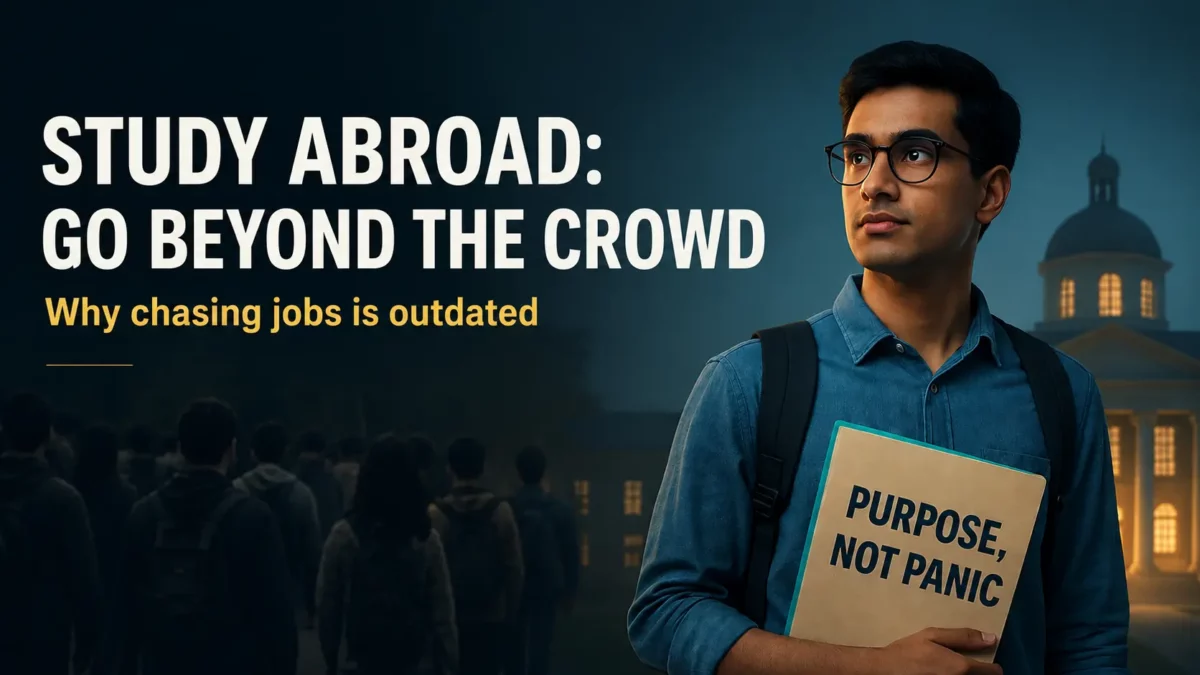


Arjun graduated from a mid-ranked US university in May 2025 with a Master’s in Information Systems. He had done everything the way he was told: picked a program with good OPT rates, applied to companies during the campus placement season, networked on LinkedIn, and waited for his H-1B lottery results.
He did not get selected in the lottery. His OPT clock was ticking. By October, he was back in Bengaluru, working at a company he could have joined straight out of his undergraduate degree, carrying a student loan of approximately INR 55 lakhs.
His story is not unusual. Versions of it played out for thousands of Indian students in 2025 and are continuing into 2026. And yet the application pattern that led to it, choose a degree for its job placement stats, target visa-friendly universities, plan your life around getting PR, is still the dominant approach among Indian students planning to go abroad.
This article is not an argument against studying abroad. Studying abroad, done right, is one of the most genuinely transformative decisions an Indian student can make. It is an argument against the specific mindset that has turned a life-expanding opportunity into a high-stakes immigration gamble for a generation of students.
The Numbers That the Job-Chasing Roadmap Ignores
The mental model that drives most Indian study abroad decisions looks like this: degree abroad, OPT or equivalent work permit, H-1B or PR, settle permanently. It made reasonable sense in 2010. The numbers in 2026 make it significantly harder to execute.
The F1 visa approval rate for Indian students stands at 39% in 2026. That means roughly four in ten students who apply do not get there in the first place. Of those who do get there, only a fraction who apply for H-1B lottery selection are chosen each year, since the lottery selects approximately one in four applicants for the general category. Add STEM OPT uncertainty under the current administration, tightened social media screening, and an increasingly competitive US job market for new international graduates, and the job-first roadmap becomes a sequence of lottery draws stacked on top of each other.
The students who understand this and still choose to go are making a different calculation entirely. They are going because the academic environment, the research access, the specific program, or the industry connection is genuinely unavailable in India. They have a reason that survives the H-1B lottery not going their way. That is a fundamentally different kind of application, and visa officers can tell the difference.
What a Job-Chasing Application Looks Like to a Visa Officer
F1 visa officers assess one thing at its core: is this person coming to the United States to study, or are they coming to stay? Section 214(b) of the Immigration and Nationality Act starts from the assumption that every applicant intends to immigrate. The burden is on the student to prove otherwise.
A job-chasing application makes that proof nearly impossible because every signal it sends points toward immigrant intent.
The university choice is driven by OPT approval rates rather than academic fit. The SOP talks about career opportunities in the US rather than research interests or specific faculty. The answer to why this program question circles back to job market access. The answer to post-study plans is vague because the honest answer is to try to stay.
Officers are not unsympathetic. They process hundreds of interviews a day and they have seen the same pattern enough times to recognise it in the first two minutes. A student who cannot articulate what they specifically want to learn, why this university, and what they will do with the degree in India is telling the officer everything they need to know.
This is not a matter of coaching students to lie better. It is a matter of students genuinely knowing why they are going. A student who is excited about a specific research lab, who can name a professor whose work directly connects to their undergraduate thesis, who has a clear picture of how the degree accelerates something they want to build in India, that student has a completely different interview. Not because they have been coached differently, but because they have something real to say.
The University Choice Problem
The job-chasing mindset produces a specific and predictable university shortlist. It is built around OPT approval statistics, placement reports, and where other students from the same city or college have gone. It heavily weights universities in tech corridors. It deprioritises academic reputation in favour of perceived visa safety.
The result is that many Indian students end up at universities that were chosen for their immigration adjacency rather than their academic substance. Visa officers know these universities. They know which ones have become feeder pipelines for immigration applications rather than genuine academic communities. Applying from one of them is not automatically disqualifying, but it adds a layer of scrutiny that a student applying from MIT, Carnegie Mellon, or even a strong state university with a specific research reputation does not face.
There is also a downstream problem. A degree from a university chosen primarily for OPT rates carries less weight in the Indian job market, in the global research community, and increasingly in the US job market itself, than a degree from a university chosen for its academic strength in a specific field. The students who think they are making a pragmatic choice are often making one that limits them both in the US and at home.
What Purpose-Driven Looks Like in Practice
Purpose-driven does not mean altruistic. It does not mean you have to want to cure cancer or solve climate change. It means you have a specific, honest reason for choosing this program at this university in this country that goes beyond visa strategy.
Here are examples of what that looks like in practice across different fields:
Engineering and Computer Science: A student targeting a specific AI research lab at a particular university because the lab’s work on large language model interpretability directly continues what they were doing in their undergraduate thesis. They can name the papers. They have emailed the professor. They know the lab’s output.
Business and Management: A student pursuing an MBA at a school with a specific entrepreneurship programme because they want to launch a company in the Indian agri-tech space and the school has a fund that invests in student ventures, plus alumni networks in both the US and India that are relevant to that sector.
Medicine and Clinical Research: A student who wants to bring clinical trial methodology back to India. They have identified which US programmes have the strongest track record in regulatory science and have a clear picture of what the Indian pharmaceutical sector needs that they can help fill.
None of these students are immune to the H-1B lottery. But all of them have something to say when a visa officer asks why this program, and all of them have a genuine plan B that does not feel like failure. That is what makes the difference both at the consulate and in life after graduation.
The Countries the Job-Chasing Mindset Makes You Miss
One of the most concrete costs of the job-first approach is that it narrows the world of options to a handful of English-speaking countries with established immigration pathways. The US, Canada, UK, and Australia dominate Indian study abroad simply because they are perceived as better immigration platforms.
This perception is increasingly outdated, and the students who are looking beyond it are finding genuinely excellent academic and career outcomes.
Germany offers free or near-free public university education for Indian students, has a well-structured job seeker visa after graduation, and has become one of the largest destinations for Indian engineers and computer scientists in Europe. The language barrier is real but manageable, and the academic standard at institutions like TU Munich, RWTH Aachen, and KIT is comparable to top American engineering schools.
Canada’s study permit environment has tightened significantly since 2024 with new caps and PAL requirements, which has reduced the value of the Canada-as-immigration-platform approach. But Canadian universities remain genuinely strong academically, and students who go for the right reasons rather than as a Canada PR stepping stone are finding the experience worthwhile.
The point is not that the US is the wrong choice. For the right student with the right program and a genuine academic reason to be there, it remains one of the most powerful academic environments in the world. The point is that the job-first filter makes students rule out genuinely excellent options that would serve them better.
What Has Changed in 2026 That Makes This More Urgent
Several things that were true in principle in 2023 and 2024 have become operationally real in 2026.
Social media screening is now mandatory for all F1 applicants. Five years of social media history is subject to review. A student whose online presence is full of content about wanting to move abroad permanently, or whose posts are inconsistent with the study intent they claim in their interview, faces additional scrutiny that did not exist two years ago.
The one-reschedule rule introduced from January 2026 means students cannot keep grabbing and releasing appointment slots while they figure out whether to proceed. Each application requires a real commitment to a specific timeline.
Interview waivers have been eliminated. Every F1 applicant in India attends an in-person interview. There is no shortcut for returning students or previous visa holders. Every application is assessed on its own merits by a consular officer.
Taken together, these changes raise the cost of an unfocused application. A student who goes to the interview without a clear, honest answer to why this program, why this university, and what they plan to do afterward is not just risking a refusal. They are risking a 214(b) mark on their file that they must disclose in every future application to Canada, the UK, Australia, and other countries that ask about prior refusals.
The Honest Conversation Most Consultants Do Not Have
The study abroad consulting industry in India is largely built on commissions paid by universities and colleges abroad. A consultant who earns a placement fee has a structural incentive to place students in universities that pay those fees, regardless of whether the university is the right fit academically or whether the student’s application is strong enough to survive consular scrutiny.
This creates a specific failure mode: students get admitted to programs they chose for the wrong reasons, coached to give interview answers that do not reflect genuine motivation, and sent into consulate interviews with applications that a careful officer can see through.
The consultants who do not earn commissions from universities, and there are a small number of them, are in a different position. When the fee comes from the student rather than the institution, the advice can be honest. If a student’s profile and motivations are not strong enough for the US right now, that conversation can happen. If Germany or Canada is actually a better fit, that can be said without losing revenue.
This is not a pitch. It is context for why the advice in this article is the kind of advice most students do not receive from the consultants they pay.
What to Do With This
If you are planning to study abroad in 2026 and your current shortlist is built around OPT rates, visa approval statistics, or where your classmates are going, pause before the application season begins and answer three questions honestly:
- What specifically do I want to learn or build that requires going abroad for?
- Which program at which university best serves that specific goal, and can I explain why?
- If I graduate and cannot stay in the country I studied in, what is the plan, and is it genuinely acceptable to me?
If you have clear, specific answers to all three, you have the foundation of a strong application. If you do not, the most useful thing you can do before spending fifty to eighty lakhs on fees and two years of your life is to work out those answers first.
At Bluehawks Edu we do not earn commissions from universities. We work with students on a no-commission basis, which means the only thing we optimise for is what is actually right for your situation. If that means telling you that your profile is not ready yet, or that Germany fits you better than the US, or that your current motivation will not survive a consulate interview, we will say it.
If you want a second opinion on your current plan, or you are building your application from scratch and want to do it properly, reach out.

The Bluehawks Editorial Team is a collaborative group of study-abroad specialists, counselors, researchers, and content experts dedicated to delivering accurate, practical, and up-to-date guidance for students planning to study overseas. Our content combines real-world experience, verified information, and deep insights into global education systems, admissions processes, visas, scholarships, and career pathways.
We create clear, student-focused resources designed to simplify complex decisions and help you explore the best opportunities across top study destinations. From application strategies to post-study outcomes, our goal is to provide trustworthy, transparent, and actionable information to support you at every step of your international education journey.