Does a US Visa Refusal Affect a Canada Study Visa?
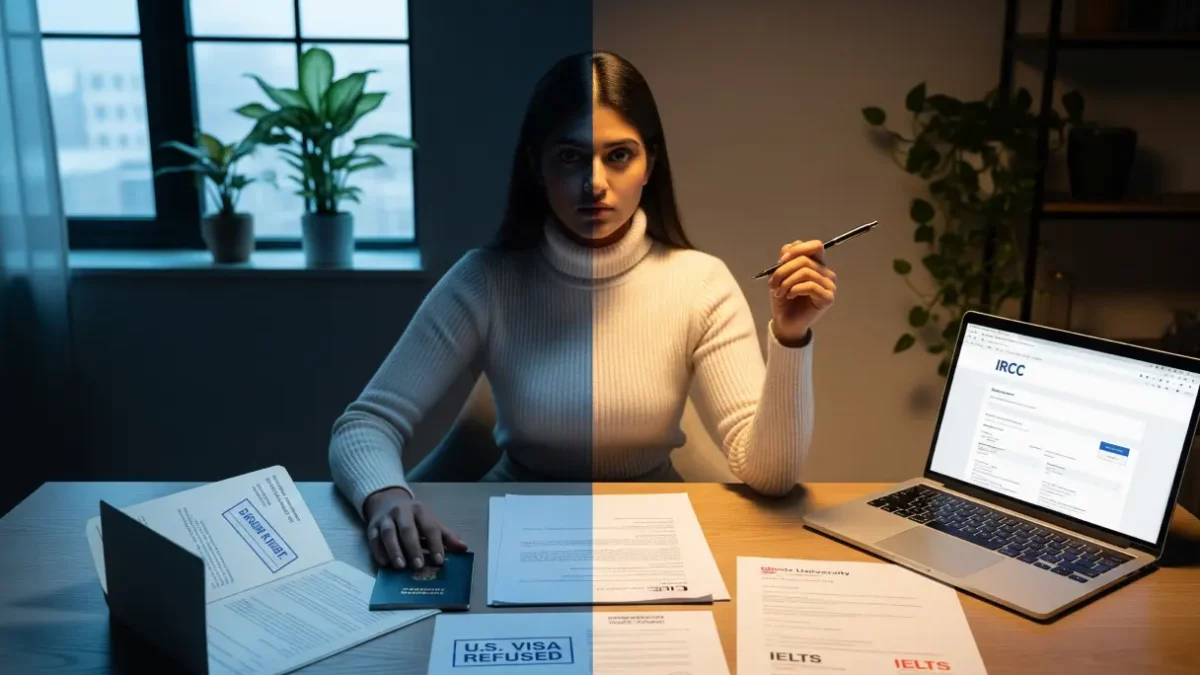


Yes, you must disclose a US visa refusal on a Canada study permit application, and no, the refusal itself is rarely what gets a Canadian application refused. IRCC assesses your Canadian application on its own terms: your study plan, your choice of institution and programme, your funds, and whether you will leave Canada when your permit expires. A US 214(b) refusal is a fact on the form, not a verdict on your Canadian case. What decides the outcome is how you explain it and whether the rest of the application makes sense.
Table of contents
You have to disclose it
The study permit application asks whether you have ever been refused a visa or permit, denied entry, or ordered to leave Canada or any other country. A US refusal, under 214(b) or any other section, is a yes. You give the country, the type of visa, the date and the reason, in your own words.
Leaving it out is the one way a US refusal can sink a Canadian application. Canada shares immigration data with the United States, and an undisclosed refusal is treated as misrepresentation, which carries a five-year ban from Canada under the immigration act. Disclose it every time.
How IRCC reads a US refusal
A 214(b) refusal means a US consular officer was not convinced you would return home after your studies. IRCC asks the same underlying question, but it asks it on paper, from your documents, with no interview. So the refusal is not ignored; it is a reason for the officer to read your study plan and your ties more carefully.
That means the US refusal matters only to the extent your Canadian application has the same weakness. If the plan is specific, the programme follows from your education, the funds are documented and the ties are real, the refusal is a line on a form. If the Canadian application is as casual as the first US attempt, the refusal confirms the officer’s doubt.
What the Canadian application has to get right for 2027
The rules changed in 2024 and 2025, and several pages still describe the old ones. The current position for Indian applicants outside Quebec:
- Proof of funds: CAD 23,448 for one year of living expenses outside Quebec (CAD 24,617 in Quebec), plus first-year tuition, plus travel. The figure rose from CAD 22,895 on 1 September 2026, and since July 2026 officers must assess where the funds came from in every application, not only in flagged ones. A Guaranteed Investment Certificate (GIC) from a participating Canadian bank is the usual way to show it.
- Provincial Attestation Letter (PAL): required with most study permit applications since January 2024; it confirms your place sits within the province’s capped allocation. Master’s and doctoral students at public institutions are exempt from 1 January 2026.
- Student Direct Stream: closed on 8 November 2024. Indian students apply through the regular study permit stream; a GIC still counts as proof of funds, but there is no fast track.
- A study plan that explains the choice: why this programme, why this institution, how it follows from your previous education, and what you will do with it at home.
The last item is where Canadian refusals actually happen. The refusal letters we see in Canada study permit refusals rarely mention a US history; they say the applicant did not justify the plan or the choice of college, or that the programme does not fit the previous education.
Common mistakes after a US refusal
- Applying to Canada as a reaction. A plan that reads as “the US said no, so Canada” has the same gap the US officer saw. The programme has to make sense on its own.
- Choosing the college for the permit, not the career. A low-cost programme with no link to your degree is exactly what IRCC’s refusal letters describe. Be specific about why this college and this programme.
- Explaining the US refusal badly. “Refused under 214(b) at Delhi” is not an explanation. Say what the officer’s concern was and what is different about this application.
- Rushing the funds. A GIC opened the week before filing, or a bank balance that appeared last month, raises more questions than it answers, and since July 2026 the source of funds is checked in every file.
- Assuming the Canadian system is lenient. There is no interview to recover a weak file. The documents are the interview.
How to write the explanation
Keep it to four or five sentences on the form or in a short letter: the date and place of the US refusal; the section; the concern as you understand it (usually ties or intent); what has changed since, or what is different about Canada in your plan; and a line that your Canadian plan is set out in the study plan. No blame, no story about the officer, no speculation. The explanation should make the officer want to read the study plan, not skip it.
What we tell students
We have not seen a Canadian refusal that was caused by a disclosed US refusal on its own. We have seen plenty caused by the same weakness that caused the US refusal: a plan the student could not justify. So our advice after a 214(b) is to decide whether Canada is the right plan, not just the next one, and if it is, to build the application as if the US refusal had never happened, then disclose it plainly. The guide to getting a US visa after 214(b) covers the other path, if the US is still the goal.
FAQ
Next steps
If a US refusal has pushed you towards Canada, start with the study plan and the choice of programme, because that is what the Canadian officer will test. The Study in Canada page covers the route and the current rules; how much money you need to live in Canada works through the budget beyond the GIC.
Yes. The form asks whether you have ever been refused a visa or permit for Canada or any other country. Answer yes, give the details, and keep the explanation factual. An undisclosed refusal is misrepresentation and carries a five-year ban.
Not by itself. IRCC assesses the Canadian application on its study plan, institution, funds and ties. A US refusal makes the officer read those more carefully; it does not decide the result.
CAD 23,448 for one year of living expenses outside Quebec (CAD 24,617 in Quebec), plus first-year tuition and travel. The figure increased from CAD 22,895 on 1 September 2026.
No. SDS closed on 8 November 2024. Indian applicants use the regular study permit stream, with a Provincial Attestation Letter for most programmes.

The Bluehawks Editorial Team is a collaborative group of study-abroad specialists, counselors, researchers, and content experts dedicated to delivering accurate, practical, and up-to-date guidance for students planning to study overseas. Our content combines real-world experience, verified information, and deep insights into global education systems, admissions processes, visas, scholarships, and career pathways.
We create clear, student-focused resources designed to simplify complex decisions and help you explore the best opportunities across top study destinations. From application strategies to post-study outcomes, our goal is to provide trustworthy, transparent, and actionable information to support you at every step of your international education journey.