Dhruv Rathee Educational Journey from India to Germany


Estimated reading time: 8 minutes
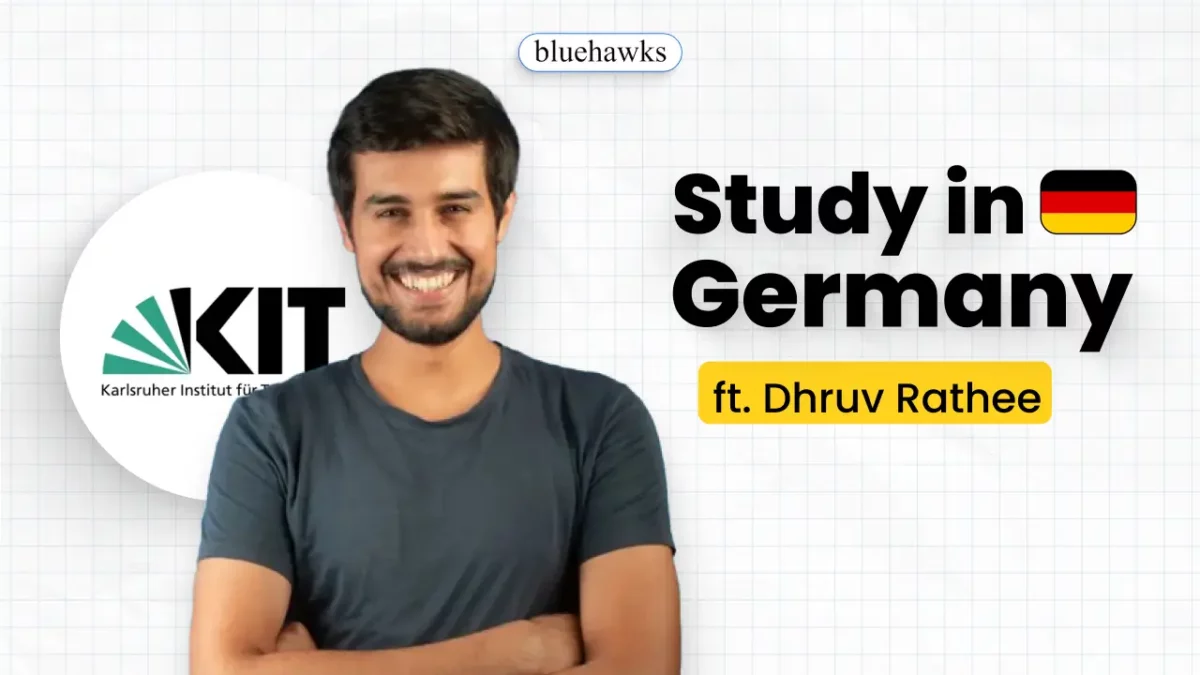
Dhruv Rathee left India at 18 to study engineering in Germany. Today Dhruv Rathee’s YouTube channel has over 31 million subscribers as of March, 2026 and is one of the most recognized Indian voices on global affairs. But before the fame, there was a university application, a student visa, and the same uncertainty that every Indian student faces when considering Germany as a study destination.
This is the story of his educational journey from India to Germany and what it practically means for Indian students who are considering the same path today.
Table of contents
- Early Life and Education in India
- Moving to Germany for Higher Education
- Bachelor’s and Master’s Degrees of Dhruv Rathee
- Professional Career and YouTube Journey of Dhruv Rathee
- Personal Life of Dhruv Rathee
- Dhruv Rathee and the Germany Study Abroad Movement
- Inspiration for Indian Students
- From Inspiration to Admission: What the Application Actually Looks Like
- Conclusion
Early Life and Education in India
Dhruv Rathee was born on October 8, 1994, in Rohtak, Haryana, India. He grew up in a Hindu Jat family and received his early education in Haryana. From a young age, Dhruv was curious and passionate about learning, which set the stage for his future endeavors.
Moving to Germany for Higher Education
After completing his schooling in Haryana, Dhruv Rathee made a decision that was uncommon for Indian students at the time — he applied directly to a German university without going through the UK or US route that most of his peers were considering.
Germany offered something specific that attracted him: tuition-free public universities with world-class engineering programs. The Karlsruhe Institute of Technology, where he eventually enrolled, consistently ranks among the top technical universities in Europe and has a strong reputation specifically in mechanical and renewable energy engineering.
For Indian students, this pathway requires an APS certificate, proof of language proficiency, and strong subject-specific academic records. Dhruv met these requirements and secured admission — a process that is entirely achievable for well-prepared Indian students today.
Bachelor’s and Master’s Degrees of Dhruv Rathee
While Dhruv attended the Karlsruhe Institute of Technology (KIT), where he earned his Bachelor’s degree in Mechanical Engineering his interest in sustainable development and environmental issues led him to pursue a Master’s degree in Renewable Energy from the same institution. This specialized education equipped him with the knowledge and skills needed to understand and address complex environmental challenges.
Here’s a quick overview of Dhruv Rathee’s educational background:
| Education Level | Field of Study | Institution | Country |
|---|---|---|---|
| Bachelor’s Degree | Mechanical Engineering | Karlsruhe Institute of Technology (KIT) | Germany |
| Master’s Degree | Renewable Energy | Karlsruhe Institute of Technology (KIT) | Germany |
What is worth noting for Indian students is that Dhruv completed both his Bachelor’s and Master’s degrees at the same institution. This is a common pattern at German universities — students who perform well in their Bachelor’s program often continue at the same university for their Master’s, which simplifies the application process considerably.
Karlsruhe Institute of Technology accepts Indian students with strong academic backgrounds in science and mathematics. The university conducts its programs primarily in German for undergraduate studies, which means prospective students need to demonstrate German language proficiency at the B2 or C1 level before applying. Dhruv would have gone through this same language requirement before beginning his Bachelor’s program.
For Indian students targeting KIT specifically, the typical profile that gets admitted includes a strong Class 12 score in Physics, Chemistry and Mathematics, an APS certificate from the German Embassy in New Delhi, and German language certification at the required level. Meeting these requirements precisely is what determines admission — not just academic scores alone.
Professional Career and YouTube Journey of Dhruv Rathee
While studying in Germany, Dhruv Rathee started his YouTube channel in 2014. Initially, it was a hobby, but his insightful content quickly gained traction. His videos, which simplify complex political, social, and environmental topics, struck a chord with viewers.
Here’s a brief timeline of Dhruv Rathee’s YouTube journey:
| Year | Milestone |
|---|---|
| 2014 | Started his YouTube channel |
| 2017 | Launched the satirical segment “Pee News” |
| 2020 | Started Dhruv Rathee Vlogs |
| 2022 | Launched a shorts channel for quick facts |
As of 2026, Dhruv Rathee’s YouTube channel has over 20 million subscribers, making him one of the most followed Indian creators in the world. His content spans political commentary, environmental issues, and travel, reaching audiences across India, Germany, and the broader Indian diaspora globally.
Dhruv has collaborated with Deutsche Welle and Netflix India, and continues to expand his reach through long-form documentary style content that has become his signature format.
Personal Life of Dhruv Rathee
Dhruv Rathee resides in Germany. In November 2021, Dhruv married Juli Lbr at Belvedere Palace in Vienna, Austria. The couple welcomed their first child in 2024.
| Personal Details | Information |
|---|---|
| Spouse | Juli Lbr |
| Marriage Date | November 2021 |
| Residence | Berlin, Germany |
Dhruv Rathee and the Germany Study Abroad Movement
There is a measurable before and after when it comes to Indian student interest in Germany, and Dhruv Rathee’s channel sits squarely in the middle of that shift.
Before his channel gained mainstream traction, Germany was considered an unconventional choice for Indian students. The UK, USA, Canada and Australia dominated the conversation. Germany was seen as complicated — language barriers, unfamiliar university systems, and a application process that felt opaque compared to the straightforward Common App or UCAS routes.
Dhruv Rathee’s visibility changed that perception for millions of young Indians. Watching someone from Rohtak, Haryana build a life and career in Germany made the country feel accessible in a way that brochures and consultancy websites never could.
The numbers reflect this shift. German student visa applications from India have grown significantly over the past five years, with India now consistently ranking among the top source countries for international students in Germany. The DAAD — Germany’s academic exchange service — has reported this trend across multiple years.
What Dhruv Rathee’s story does not show, however, is the application process behind the journey. The APS certificate. The language requirements. The university-specific admission criteria. The blocked account requirement for the visa. These are the practical realities that every Indian student faces when turning the inspiration into an actual application.
That gap between inspiration and execution is exactly where informed guidance makes the difference.
Inspiration for Indian Students
Dhruv Rathee’s journey offers more than motivation — it offers a practical blueprint that Indian students can actually follow.
1. Germany is accessible without a top-tier college background
Dhruv did not come from an IIT or NIT. He was a student from Haryana who met the specific admission requirements of a German university. This is the most important lesson his story offers — German universities evaluate applicants on subject-specific academic alignment, language proficiency, and documentation precision. Your college brand matters far less than your preparation quality.
2. Engineering and technology are Germany’s strongest suits
Dhruv chose Mechanical Engineering at KIT — one of Germany’s most respected programs in exactly that field. Indian students considering Germany should prioritize universities with strong track records in their specific discipline rather than chasing general rankings.
3. The language investment pays off
Dhruv learned German to study at KIT. For undergraduate programs at most German public universities, B2 or C1 German proficiency is not optional — it is a hard requirement. Students who invest in German language preparation early open significantly more doors than those who limit themselves to English-taught programs.
4. Starting early matters more than starting perfectly
Dhruv began his YouTube channel while still a student — not after achieving success. Indian students who start building their Germany application profile in Class 11 rather than after Class 12 results consistently have stronger outcomes. The APS certificate process alone takes time, and German language preparation cannot be rushed.
From Inspiration to Admission: What the Application Actually Looks Like
Dhruv Rathee’s story makes Germany feel possible. What it does not show is the paperwork, the rejections, and the preparation that the journey requires.
At Bluehawks EduAbroad, we have worked with Indian students applying to German universities since 2016. In that time we have seen what separates students who get admitted from students who get rejected — and it rarely comes down to CGPA alone.
The most common reasons Indian students get rejected from German universities are not low grades. They are incomplete documentation, incorrect ECTS credit mapping, SOPs written for a UK or US audience rather than a German admissions committee, and university selections made without understanding each program’s specific admission threshold.
Vishal Gupta came to us after being rejected by four German universities. His CGPA was 7.11. His IELTS was 6 bands. On paper he looked like a borderline candidate. But after we rebuilt his application strategy — identifying universities where his coursework genuinely matched admission requirements, rewriting his SOP for a German audience, and adding a proper cover letter — Kiel University not only considered him but invited him for an oral interview.
He passed. He is now studying Computer Science at Kiel University.
This is what informed guidance looks like in practice. Not guaranteed admissions. Not shortcuts. A precise strategy built around your specific profile and the specific requirements of the universities you are targeting.
If you are considering Germany and want an honest assessment of where your profile stands, we are happy to help.
Conclusion
Dhruv Rathee’s journey from Rohtak to Karlsruhe is not an exception. It is a repeatable path that thousands of Indian students have followed and continue to follow every year.
What makes the difference is not exceptional talent or an elite college background. It is preparation — the right university selection, the right documentation, and a clear understanding of what German admissions committees actually evaluate.
Germany remains one of the most accessible high-quality study destinations for Indian students willing to put in that preparation. Tuition-free public universities, globally respected engineering programs, and a post-study work environment that genuinely values international talent make it a compelling choice for the right student.
If Dhruv Rathee’s story has made you curious about what studying in Germany could look like for you specifically, the next step is understanding your own profile honestly — what works in your favor, what needs strengthening, and which universities are realistic targets given where you stand today.
That is a conversation we are always happy to have.
🙋♂️ Chat with our 24/7 support team! Just tap the WhatsApp button in the bottom right corner ↘️🟢
Related Links

The Bluehawks Editorial Team is a collaborative group of study-abroad specialists, counselors, researchers, and content experts dedicated to delivering accurate, practical, and up-to-date guidance for students planning to study overseas. Our content combines real-world experience, verified information, and deep insights into global education systems, admissions processes, visas, scholarships, and career pathways.
We create clear, student-focused resources designed to simplify complex decisions and help you explore the best opportunities across top study destinations. From application strategies to post-study outcomes, our goal is to provide trustworthy, transparent, and actionable information to support you at every step of your international education journey.