
Germany Student Visa Rejection Reasons and Mistakes to Avoid


Estimated reading time: 10 minutes
Last updated: September 2026. Visa procedures change often. Confirm the current requirements with the German missions in India and on the Consular Services Portal before you apply.
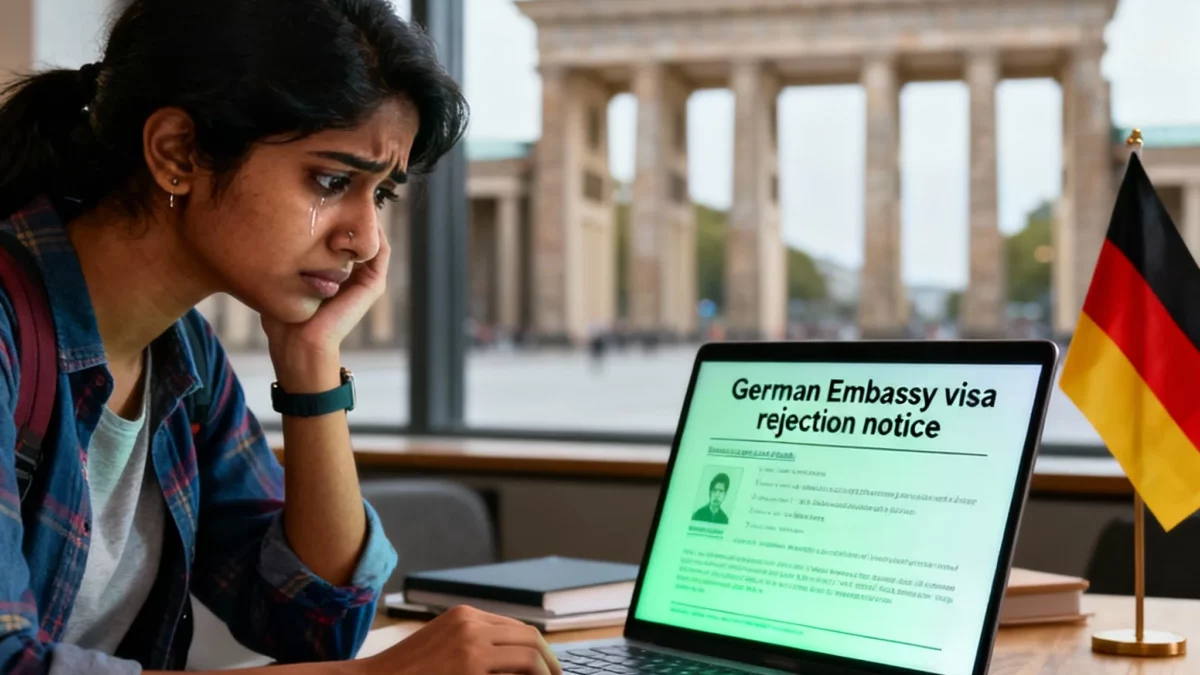
Most Indian students who apply for a German student visa get one. The students who are refused are often surprised, because they had an admission letter and a funded blocked account and assumed that was enough.
It isn’t. A university decides whether you are academically eligible. The visa section decides something different: whether your plan to study in Germany is credible, properly funded and correctly documented. Most refusals come down to avoidable mistakes in one of those three areas.
This guide explains the mistakes we see most often, shares a real case of a student who was refused and then approved, and sets out what to do if you have already been refused.
Table of contents
The short answers
| Question | Answer |
|---|---|
| Why are German student visas refused? | Usually because the study plan isn’t credible, the documents contain errors, or the finances don’t add up. Rarely because of one missing paper. |
| Can I appeal informally? | No. The informal appeal (remonstration) was abolished on 1 July 2025. |
| What are my options after a refusal? | A fresh application that fixes the stated reasons, or a formal court challenge. |
| Can I reapply straight away? | Yes. There is no mandatory waiting period, but reapplying with the same file will usually fail again. |
The most common mistakes at a glance
- Choosing a programme with no clear connection to your previous studies
- Not explaining how the programme leads to your future plans
- Choosing a university with little academic screening, without a strong reason
- Applying with a borderline language score
- Submitting a generic motivation letter
- Mismatched dates, names or addresses across documents
- Renaming, merging or editing the APS certificate
- Depositing less than the required amount in the blocked account
- Large deposits with no documented source
- Health insurance that doesn’t meet the mission’s requirements
Each one is explained below.
Admission is not a visa
A university admits you because you meet its academic entry requirements. The visa officer looks at your whole file and asks a different set of questions:
- Does this programme make sense given what you have studied so far?
- Can you realistically complete it in the language of instruction?
- Is there a clear reason you are going to Germany to study, and a plan for afterwards?
- Is the money genuine, sufficient and correctly documented?
- Does every document tell the same story?
An admission letter from a university that screened you properly helps you answer those questions. An admission letter from an institution that admits almost everyone can make them harder to answer. We explain why in Why “Guaranteed Admission” Can Cost You Your Germany Dream.
Common mistakes that lead to refusal
Study plan credibility
The programme doesn’t connect to your background. If you studied commerce and are now applying for photography, or engineering after an arts degree, the officer will want to know why. Changing field is allowed, but the connection has to be real and clearly explained, through coursework, work experience, a portfolio or a well-reasoned career plan.
No clear link between the programme and your future plans. This is one of the most common reasons we see. Officers want to understand what the degree leads to. “I want international exposure” is not a plan. A specific role, industry or next step is.
A university with little academic screening. Some private institutions admit students with very little assessment. That in itself doesn’t mean refusal, but it can lead officers to ask whether the real purpose of the stay is study, or work and migration. The weaker the admission process, the stronger the rest of your file needs to be.
Language scores that are only just enough. Some private universities accept IELTS 6.0 for English-taught programmes. The visa section may still doubt that you can manage university-level study at that level. For English-taught degrees, 6.5 or above puts you on much safer ground. For German-taught degrees, you need the certified German level your programme requires.
A generic motivation letter. Lines like “Germany has world-class education” or “I have always dreamed of studying abroad” tell the officer nothing. Explain why this programme, why this university, and what you will do with the degree.
Paperwork
Errors in the online application. National visa applications are now submitted through the Consular Services Portal before your VFS appointment. Wrong campus addresses, mismatched dates, spelling differences between documents and missing uploads all create doubt. Check every field against your admission letter and passport.
A modified APS certificate. Submit the APS PDF exactly as you received it. Do not rename it, merge it with other documents or edit it in any way. Altered files can fail verification and delay your application.
Health insurance that doesn’t meet requirements. You need valid cover from your arrival until you enrol and switch to German student health insurance. Use a policy the mission accepts, not the cheapest travel policy you can find.
Incomplete or uncertified documents. Missing marksheets, translations that aren’t certified, or pages left out of transcripts can all lead to delays or refusal.
Money
Too little in the blocked account. For a degree programme, the standard is €11,904 for one year (€992 a month). Language-course visas need more: €13,092. Depositing less, or using an account type the mission doesn’t accept, is a common and entirely avoidable mistake.
Funds with no clear source. Large deposits made shortly before you apply, with no explanation, can raise questions. Keep records of where the money came from, particularly if an education loan or a family member is involved.
Weak sponsor or loan documents. If someone is sponsoring you, or tuition is due at a private university, the paperwork must be complete and consistent.
Bachelor’s and preparatory routes
Eligibility problems. From Winter Semester 2026/27, Indian applicants need at least 70% overall in Class XII for both the Studienkolleg route and direct admission after a year of university study. If your eligibility is in doubt, the whole application is weaker. See our guide to Bachelor’s in Germany After First Year in India.
Language-course or Studienkolleg visas without a clear next step. A visa for a language course or preparatory year should lead clearly into a degree. Officers look for a realistic plan and the correct level of funding.
A real case: refused, then approved
A student from Punjab came to us after her German student visa was refused. Her first application had been prepared by another consultancy, for a bachelor’s degree in photography and new media at a private university.
The refusal set out several problems:
- no academic connection between her previous education and the programme;
- no convincing link between the programme and her future plans;
- incorrect campus and programme location details in the application;
- an IELTS score of 6.0, which the mission did not consider sufficient for university-level study;
- an admission that appeared to rest on non-academic criteria.
None of her documents was fake. The application simply didn’t hold together.
We did not resubmit the same file. We reassessed her profile from the start and chose a public university programme that was relevant to her background and to what she wanted to do next. We then rebuilt her motivation letter around that connection and checked every detail in the file for consistency.
Her second application was approved.
The lesson is not that private universities are always a problem. It is that the programme, the university and the student’s plans have to make sense together. A first application built around the easiest admission rather than the right programme can cost a student months.
What to do after a refusal
There is no informal appeal any more. Germany abolished the remonstration procedure worldwide from 1 July 2025. You have two options:
- Submit a fresh application. Fix the specific reasons in your refusal notice, gather corrected or additional documents and apply again, paying the fees again. This is the right route for most students.
- Challenge the decision in court. Judicial review is still available, but it is slow and costly and needs a German lawyer. It is realistic only if you believe the refusal was legally wrong, not simply because you disagree with it.
Before you reapply:
- Read your refusal notice carefully. It states the grounds. Your new application has to address each one directly.
- Don’t resubmit the same file. An identical application will almost certainly be refused again.
- Check whether your admission is still usable. Your APS certificate normally remains valid. Your admission, however, is for a particular semester. If that semester’s start date has passed, you may need a deferral or a new admission.
- Ask whether the programme is right. If the refusal was about programme fit or future plans, a better-written motivation letter may not be enough. Sometimes the right fix is a different programme or university, as in the case above.
- Declare the refusal honestly in future visa applications wherever you are asked about previous refusals.
For another refusal-to-admission story, read Master’s in Germany After Rejection: The Kiel University Story.
Checklist before you submit
- Programme connects clearly to your previous studies, or the change of field is well explained
- Motivation letter explains why this programme, why this university and what comes next
- Language score comfortably meets the programme’s requirement
- Blocked account holds the correct amount for your visa type, with a provider the mission accepts
- Source of funds documented for any large deposits
- APS certificate uploaded exactly as issued
- Every date, address and name matches across all documents
- Health insurance meets the mission’s requirements
- Certified translations for every document not in English or German
- Consular Services Portal application checked field by field before booking VFS
FAQs
What are the most common mistakes in a German student visa application?
The most common are choosing a programme with no clear link to your previous studies or future plans, and submitting a generic motivation letter. Mismatched dates, names or addresses across documents are also frequent. On the money side, depositing less than the required blocked-account amount, or making large deposits with no documented source, causes many problems. Renaming or merging the APS certificate PDF is a small mistake that can still cause verification problems.
Can I reapply immediately after a German student visa refusal?
Yes, there is no mandatory waiting period. A new application only makes sense once you have fixed the reasons given in your refusal notice.
Can I appeal a German student visa refusal?
Not informally. The remonstration procedure ended on 1 July 2025. You can reapply, or challenge the decision in court.
Will a refusal affect future visa applications?
A previous refusal does not automatically bar you from a future visa, but you must declare it where asked. A strong, well-corrected application can still succeed, as the case above shows.
Is a private university a reason for refusal?
Not by itself. Problems arise when admission appears to have required little academic assessment and the rest of the file doesn’t show a clear, credible study plan.
Should I change university after a refusal?
Only if the refusal was about programme fit or the credibility of your plans. If it was about a paperwork error or funding, fixing that may be enough.
What IELTS score do I need for a German student visa?
It depends on your programme. For English-taught degrees, 6.5 or above is considerably safer than a borderline 6.0.
How Bluehawks Edu can help
We are a commission-free consultancy. Students pay us directly, and we take nothing from universities, so we have no reason to steer you towards an institution that is easy to get into but hard to get a visa for.
We have worked with hundreds of Indian students on their plans for Germany, including many who came to us after a refusal. We can help with:
- refusal review: reading your refusal notice and identifying what actually needs to change;
- programme and university choice: focused on public universities and programmes that fit your background;
- motivation letters: built around a genuine connection between your studies and your plans;
- document checks: APS, Consular Services Portal and VFS files checked for consistency before you submit;
- language preparation: German and IELTS.
Our chat support team is available 24/7. or send us an enquiry.
Related reading: Study in Germany · Germany Study Visa 2026: What Indian Students Must Know

The Bluehawks Editorial Team is a collaborative group of study-abroad specialists, counselors, researchers, and content experts dedicated to delivering accurate, practical, and up-to-date guidance for students planning to study overseas. Our content combines real-world experience, verified information, and deep insights into global education systems, admissions processes, visas, scholarships, and career pathways.
We create clear, student-focused resources designed to simplify complex decisions and help you explore the best opportunities across top study destinations. From application strategies to post-study outcomes, our goal is to provide trustworthy, transparent, and actionable information to support you at every step of your international education journey.