
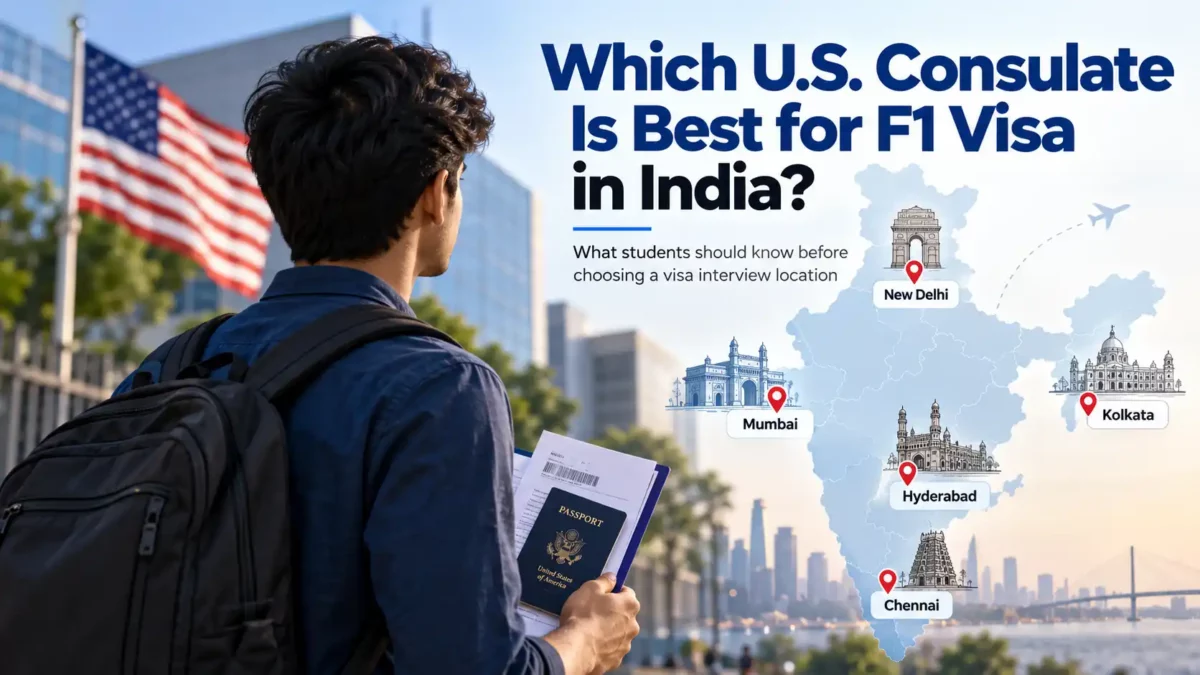
Which US Consulate Is Best for F1 Visa in India?


Estimated reading time: 14 minutes
If you are applying for an F1 student visa, you may have come across questions like:
Which US consulate is best for F1 visa in India?
Does Chennai have a higher F1 visa approval rate?
Is Kolkata better for second-time F1 visa applicants?
Should I change my consulate after an F1 visa refusal?
These questions are extremely common, particularly among students discussing their applications in WhatsApp and Telegram groups.
But there is an important distinction between what students believe about different consulates and what can actually be established from reliable information.
There is no publicly available official data that establishes one Indian consulate as having a universally higher F1 visa approval rate than another.
More importantly, choosing a particular consulate should not be treated as a strategy for overcoming weaknesses in your application.
Key Takeaways
- There is no officially published F1 visa approval ranking for Indian U.S. consulates that allows applicants to reliably identify a “best” consulate.
- Visa issuance volumes are not the same thing as approval rates.
- Student discussions about Chennai, Hyderabad, Mumbai, Delhi or Kolkata often involve anecdotes rather than representative data.
- There is no reliable public evidence that Kolkata is inherently better for second-time F1 visa applicants.
- If you have previously been refused, changing the location of your interview does not by itself fix the reasons for the previous refusal.
- Your academic plans, finances, university choice, career goals, credibility and interview preparation generally matter far more than trying to find a supposedly “lucky” consulate.
- Current U.S. Department of State guidance says nonimmigrant visa applicants should generally schedule interviews in their country of nationality or residence, subject to the applicable exceptions and instructions.
Table of contents
- Key Takeaways
- Which U.S. Consulate Should You Choose for an F1 Visa?
- Which U.S. Consulate Has the Highest F1 Visa Approval Rate in India?
- “What Is the F1 Visa Approval Rate at Chennai?”
- Is Kolkata Good for Second-Time F1 Visa Applicants?
- What Students Actually Discuss in WhatsApp and Telegram Groups
- We Have Also Seen Another Pattern
- Choosing a particular consulate is not a substitute for fixing a weak application.
- Does the Consulate Affect Your F1 Visa Approval Chances?
- Mumbai vs Chennai vs Hyderabad vs New Delhi vs Kolkata
- What About Visa Appointment Wait Times?
- Common Myths About Choosing an F1 Visa Consulate
- Myth 1: “One Indian consulate has the highest F1 approval rate.”
- Myth 2: “Chennai is always better for F1 applicants.”
- Myth 3: “Kolkata is better for second-time applicants.”
- Myth 4: “Changing the consulate after a refusal increases your chances.”
- Myth 5: “A particular officer is known for approving students.”
- Myth 6: “If my consultant sends me to a particular consulate, my chances are higher.”
- What Actually Matters More Than the Consulate?
- What If You Have Already Been Refused?
- How to Prepare for Your F1 Visa Interview
- What Is More Important: Consulate or Applicant Profile?
- So, Which Consulate Is Best for F1 Visa in India?
- Frequently Asked Questions
- Need Help Preparing for Your F1 Visa Interview?
Which U.S. Consulate Should You Choose for an F1 Visa?
The first thing to understand is that you should not choose a consulate simply because someone on WhatsApp, Telegram, YouTube or an online forum says that it has a higher F1 approval rate.
The U.S. Department of State’s current guidance says that, effective July 15, 2026, nonimmigrant visa applicants should generally schedule their visa interview at a U.S. Embassy or Consulate in their country of nationality or residence. Applicants applying based on residence must be able to demonstrate that residence.
For applicants in India, the U.S. has visa-issuing posts including:
- U.S. Embassy New Delhi
- U.S. Consulate General Mumbai
- U.S. Consulate General Chennai
- U.S. Consulate General Hyderabad
- U.S. Consulate General Kolkata
The Department of State publishes information about these posts, but that does not mean that one of them is officially designated as the “best” consulate for F1 applicants.
So instead of asking:
“Which consulate has the highest approval rate?”
a better question is:
“Where am I eligible to apply, and how well prepared is my application?”
Which U.S. Consulate Has the Highest F1 Visa Approval Rate in India?
This is probably the most searched question around F1 consulate selection.
And it is also one of the questions where applicants should be particularly careful with numbers circulating online.
The U.S. Department of State publishes visa issuance statistics by post. However, visa issuance volume is not the same thing as an approval rate.
For example, one consulate may issue more nonimmigrant visas simply because it processes a larger number of applications.
That does not establish that an individual applicant has a higher probability of receiving an F1 visa there.
Therefore, claims such as:
- “Chennai has the highest F1 approval rate.”
- “Kolkata gives more visas.”
- “Mumbai has become strict.”
- “Hyderabad is better for freshers.”
- “Delhi is best for strong profiles.”
should not be treated as established facts unless the person making the claim can provide reliable, representative data.
Why approval-rate claims are difficult to verify
To calculate a meaningful approval rate, you would need reliable data on the relevant applicant population, including applications and outcomes.
A simple count of visas issued does not provide that denominator.
The Department of State’s published statistics can therefore tell us how many visas were issued at a particular post, but they should not be interpreted as a ranking of your individual chances of approval.
This distinction matters because a student deciding where to apply is making a high-stakes decision based on these discussions.
“What Is the F1 Visa Approval Rate at Chennai?”
This is a question we hear frequently from students.
Chennai handles a significant volume of U.S. visa applications, and students often discuss it extensively in F1-focused WhatsApp and Telegram groups.
But a large issuance volume should not automatically be interpreted as a higher F1 approval rate.
If someone tells you:
“Chennai has an X% F1 approval rate.”
the sensible follow-up question is:
“What is the source of that percentage?”
Is it official U.S. government data?
Is it based on a representative sample?
Does it include refusals?
Does it distinguish F1 applicants from other nonimmigrant visa categories?
Does it account for applicants’ profiles?
Without that information, the number may simply be an anecdotal estimate circulating among applicants.
Is Kolkata Good for Second-Time F1 Visa Applicants?
This is another question that comes up frequently.
Students who have received an F1 visa refusal often discuss whether they should:
- change their consulate,
- apply at Kolkata,
- move from Mumbai to Chennai,
- move from Delhi to Hyderabad,
- or choose another location for their second attempt.
You will also find claims online that a particular consulate is “better for second timers.”
There is no reliable public evidence establishing that Kolkata is inherently better for second-time F1 applicants.
A change of interview location does not automatically change the substance of your application.
For a student who has previously been refused, the more important question is:
What has changed or improved since the previous interview?
If your previous interview exposed weaknesses in your academic rationale, finances, university selection, career plans or communication, simply appearing at another consulate does not eliminate those weaknesses.
What Students Actually Discuss in WhatsApp and Telegram Groups
If you spend time in WhatsApp or Telegram groups aimed at F1 applicants and F1 refusal applicants, you will quickly notice how much attention is given to consulate selection.
Students ask:
- “Which consulate is giving the most visas?”
- “What is the acceptance rate at Chennai?”
- “Is Kolkata good for second attempts?”
- “Which consulate is lenient?”
- “Where should I go after a 214(b) refusal?”
- “Which consulate has the best officers?”
- “Should I change my location?”
These discussions get a lot of attention because students naturally want to find something they can control.
After a refusal, it can feel much easier to think:
“Maybe I chose the wrong consulate.”
than to ask the harder question:
“What was weak about my application, and what am I going to do differently this time?”
That is where applicants need to be careful.
Anecdotes can be useful for understanding what other students experienced. They are not necessarily evidence that the same outcome will happen to you.
We Have Also Seen Another Pattern
In conversations with F1 applicants, students sometimes tell us that their local agent or consultancy recommended a particular consulate.
The reasoning may sound something like:
“This consulate is better for students.”
or:
“You have a better chance there.”
or:
“Students with your profile are getting approved there.”
Sometimes the student follows that recommendation and is still refused.
This does not necessarily mean the consultant caused the refusal.
It does, however, demonstrate an important point:
Choosing a particular consulate is not a substitute for fixing a weak application.
A student can choose the consulate everyone in a Telegram group recommends and still be refused.
Another student can appear at the same consulate and be approved because their academic plan, financial situation, communication and overall application are convincing.
The location alone does not explain the outcome.
Does the Consulate Affect Your F1 Visa Approval Chances?
The consulate matters in the sense that your visa interview takes place there and the post has its own appointment availability and operational procedures.
But that is very different from saying:
“This consulate gives F1 visas more easily.”
The U.S. visa process is governed by federal immigration and visa laws and the individual application is adjudicated by a consular officer.
Applicants should therefore be cautious about turning differences in individual experiences into a broad rule.
There can be differences in:
- appointment availability,
- wait times,
- operational procedures,
- workload,
- interview experience,
- and individual officer interactions.
But these factors should not be confused with a guaranteed difference in your probability of approval.
Mumbai vs Chennai vs Hyderabad vs New Delhi vs Kolkata
Students frequently compare Indian posts as though there is a fixed ranking.
There isn’t a reliable public F1 approval ranking that should be used for this purpose.
Instead, consider the following:
| Question | What you should actually consider |
|---|---|
| Chennai | Is this an appropriate post for your circumstances, and can you obtain an appointment? |
| Hyderabad | Does it fit your nationality/residence eligibility and current appointment availability? |
| Mumbai | Is it an appropriate post, and are you prepared for the interview? |
| New Delhi | Does it fit your circumstances and current visa instructions? |
| Kolkata | Is there a legitimate reason to apply there rather than simply relying on online claims? |
The current Department of State guidance and the individual post’s instructions should take priority over older advice circulating in student communities.
What About Visa Appointment Wait Times?
This is one area where consulate differences are genuinely relevant.
Appointment availability can vary between posts and can change over time.
The Department of State publishes estimated visa appointment wait times and notes that additional appointments can become available. It also recommends checking back if you want an earlier appointment.
But remember:
Appointment availability is not the same thing as visa approval probability.
A student may reasonably consider appointment availability when planning the application.
That is very different from choosing a location because someone claims:
“Students get approved more easily there.”
Common Myths About Choosing an F1 Visa Consulate
Myth 1: “One Indian consulate has the highest F1 approval rate.”
There is no reliable official F1 approval-rate ranking that establishes this.
Be careful with percentages circulating on social media or student groups.
Myth 2: “Chennai is always better for F1 applicants.”
Chennai may process a large volume of visas, but issuance volume should not be confused with an individual applicant’s approval probability.
Myth 3: “Kolkata is better for second-time applicants.”
There is no reliable public evidence establishing this as a general rule.
For a second attempt, the more important question is what has changed since the previous refusal.
Myth 4: “Changing the consulate after a refusal increases your chances.”
Changing the interview location does not automatically change the underlying application.
If the weaknesses remain, the refusal risk may remain as well.
Myth 5: “A particular officer is known for approving students.”
Consular officers can change, and individual anecdotes cannot reliably predict how another application will be adjudicated.
Do not build your entire strategy around stories about individual officers.
Myth 6: “If my consultant sends me to a particular consulate, my chances are higher.”
A consultant can help you understand the process and prepare your application.
But no consultant can guarantee that a particular consulate will approve your visa.
What Actually Matters More Than the Consulate?
If you are trying to maximize the quality of your F1 application, there are much more productive questions to ask.
1. Why this university?
Can you explain your choice naturally?
Not just:
“It is a good university.”
But:
- Why this university?
- Why this program?
- Why this curriculum?
- Why this location?
- Why does it fit your previous education?
- What specific skills will you gain?
2. Why this course?
Your academic progression should make sense.
A consular officer should be able to understand why the program is a logical next step for you.
3. Why the United States?
You should be able to explain why studying in the U.S. makes sense for your particular academic and career objectives.
Generic answers are easy to memorize and easy to forget.
4. How are you funding your education?
Your financial story should be clear and credible.
You should understand:
- who is funding your education,
- what the source of funds is,
- how tuition and living expenses will be covered,
- and how the overall financial plan makes sense.
5. What are your career plans?
Your answer should connect your education to your longer-term career trajectory.
You don’t need to recite a speech.
You need to understand your own plan.
6. Can you communicate your story clearly?
F1 interviews are usually short.
That means your ability to communicate clearly and directly matters.
The objective isn’t to give the longest answer.
It is to give the right answer clearly.
What If You Have Already Been Refused?
This is where consulate-selection discussions become particularly dangerous.
After a refusal, students often start looking for patterns:
“My friend got rejected at Chennai.”
“Someone got approved at Kolkata.”
“Let’s try Mumbai this time.”
“Everyone says Hyderabad is better.”
The temptation is to change the location and hope for a different outcome.
Instead, start with the previous interview.
Ask:
What happened?
What questions were asked?
Where did you hesitate?
Which answers were unclear?
Did you provide a convincing explanation of your university and program?
Did your career plan make sense?
Was your funding easy to explain?
Did your answers sound rehearsed?
Did your academic progression make sense?
Did the officer seem unconvinced about a particular aspect of your case?
Then ask:
What has actually changed?
If nothing meaningful has changed, changing the consulate may simply change the location of the interview rather than the quality of the application.
For applicants refused under INA 214(b), the Department of State notes that reapplying can make sense when the applicant can present additional evidence of qualification or there have been significant changes in circumstances.
F1 Visa Rejected 214B: What to Do Next
How to Prepare for Your F1 Visa Interview
Instead of spending weeks trying to discover the “best” consulate, spend that time making sure you understand your own application.
Know your university
You should be able to explain:
- why you chose it,
- why the program fits you,
- what you will study,
- and how it connects with your previous education.
Know your finances
Understand your funding completely.
You should not depend on someone else to explain your own financial situation.
Know your career plan
Your education should have a logical connection to what you intend to do professionally.
Review your previous refusal
If you have been refused before, understand what you did differently this time.
Practice without memorizing
Mock interviews can be useful, but your goal should not be to memorize perfect answers.
Your answers should sound like your answers.
What Is More Important: Consulate or Applicant Profile?
Consider two students.
Student A
- Chooses the consulate recommended by everyone in a WhatsApp group.
- Has memorized answers.
- Cannot clearly explain why the university was selected.
- Is uncertain about finances.
- Gives generic answers about career plans.
- Has not addressed the weaknesses from a previous refusal.
Student B
- Applies at an appropriate post.
- Understands the university and program.
- Has a coherent academic progression.
- Can explain the funding clearly.
- Has realistic career objectives.
- Understands what went wrong in the previous interview.
- Has prepared without sounding scripted.
Which student has done the more important preparation?
The answer has little to do with whether the interview happens in Chennai, Kolkata, Mumbai, Hyderabad or New Delhi.
So, Which Consulate Is Best for F1 Visa in India?
There is no universally “best” U.S. consulate for F1 visa applicants in India.
The better approach is to:
- Follow the current eligibility and appointment guidance from the U.S. Department of State.
- Choose an appropriate post based on your nationality/residence and the applicable rules.
- Consider legitimate logistical factors such as appointment availability.
- Do not rely on unverified approval-rate claims from WhatsApp, Telegram or social media.
- If you have been refused before, focus on what has changed in your application rather than simply changing the interview location.
- Prepare your academic, financial and career story thoroughly.
The consulate is where your interview happens.
Your application is what you are actually being interviewed about.
Frequently Asked Questions
Sources: appointment availability and wait times are published on the State Department’s global visa wait times page; post-specific notices for Delhi, Mumbai, Chennai, Hyderabad and Kolkata are on the U.S. Embassy and Consulates in India site.
There is no officially established “best” U.S. consulate for F1 applicants in India. Your choice should be based on current U.S. visa rules, your eligibility to apply at the post and practical factors such as appointment availability.
There is no reliable official ranking of Indian U.S. consulates by F1 approval rate. Visa issuance figures should not be confused with approval percentages.
Chennai processes a large number of U.S. visas, but that does not establish that an individual F1 applicant has a higher chance of approval there.
There is no reliable public evidence that Kolkata is inherently better for second-time F1 applicants. A second application should primarily address the weaknesses or circumstances associated with the previous refusal.
Not simply because someone says another consulate is easier. First understand why the previous application was refused and whether anything meaningful has changed.
Current U.S. Department of State guidance says nonimmigrant visa applicants should generally schedule interviews in their country of nationality or residence, subject to applicable exceptions. Always verify the latest official instructions before scheduling.
The exact interview experience can vary, but applicants should prepare for questions about their education, university, program, finances and future plans rather than trying to predict a particular officer’s questions.
Changing the interview location does not automatically fix weaknesses in an application. If you have been refused, focus first on understanding and addressing the reasons your application was not convincing.
Treat them as anecdotal unless they are supported by reliable, representative data. Student groups can be useful for sharing experiences, but individual experiences do not establish an approval-rate trend.
Need Help Preparing for Your F1 Visa Interview?
If you are preparing for your first F1 visa interview or applying again after a refusal, the most productive place to start is not by finding a “lucky” consulate.
It is by understanding why your application should make sense to a consular officer.
At Bluehawks Edu, our F1 visa preparation focuses on understanding the student’s individual profile, reviewing the application, identifying potential weaknesses and preparing for the interview through structured practice.
F1 Visa Refusal – What to Do After a Rejection
F1 Visa Interview Questions and Answers
The goal is not to find a consulate that will approve you. The goal is to build an application and interview that you can confidently defend. Need help with your F1 visa preparation? Contact us or chat with our 24/7 live support team

The Bluehawks Editorial Team is a collaborative group of study-abroad specialists, counselors, researchers, and content experts dedicated to delivering accurate, practical, and up-to-date guidance for students planning to study overseas. Our content combines real-world experience, verified information, and deep insights into global education systems, admissions processes, visas, scholarships, and career pathways.
We create clear, student-focused resources designed to simplify complex decisions and help you explore the best opportunities across top study destinations. From application strategies to post-study outcomes, our goal is to provide trustworthy, transparent, and actionable information to support you at every step of your international education journey.